
Reviewed by Alex J., Lead HVAC Technician, NATE Certified
Why Spring Is the Right Time to Catch This Problem
Most Sacramento homeowners don't think about their AC until the first real heat wave rolls through in late May or June. By then, if something's wrong, you're calling for service along with half of Citrus Heights and Folsom—and waiting in line for it.
April is the smart window. It's warm enough to run your system for a few minutes and catch problems early, but not so hot that a broken AC turns your house into a crisis. Low refrigerant is one of those problems that sneaks up on you. It doesn't announce itself loudly. Instead, it slowly makes your system work harder and cool less, right up until the moment it can't keep up at all.
If your AC seemed a little off last summer—slow to cool, running longer than usual, never quite hitting the target temperature—refrigerant could be why.
What Refrigerant Actually Does
Refrigerant is the substance that makes cooling possible. It cycles through your system, absorbing heat from inside your home and releasing it outside. Without the right charge (the correct amount of refrigerant under the correct pressure), your AC can run all day and still not move heat effectively.
Here's something that surprises a lot of homeowners: refrigerant isn't consumed like gas in a car. A properly sealed system keeps the same refrigerant indefinitely. If yours is low, that means there's a leak somewhere—a pinhole in a coil, a loose fitting, a failing valve. The refrigerant didn't just disappear; it escaped, and the leak is still there.
That matters because topping off refrigerant without finding and fixing the leak is a temporary fix at best. The level will drop again, and in the meantime, refrigerant can damage your compressor, which is the most expensive component in the system.
Signs Your AC Refrigerant Might Be Low
None of these signs are definitive on their own, but if you're seeing two or three together, it's worth having a technician take a look before summer arrives.
The air coming out of your vents is warm or barely cool. This is the most obvious one. If your system is running but the air feels closer to room temperature than cold, something is preventing heat transfer. Low refrigerant is a common reason.
Your AC runs constantly but never reaches the set temperature. A properly charged system should cycle on and off. If yours is running nonstop trying to hit 74 degrees and falling short, it's working harder to accomplish less—a classic sign of refrigerant problems.
You see ice forming on the refrigerant lines or the indoor coil. This sounds counterintuitive—ice means it's too cold, right? Actually, when refrigerant is low, the pressure in the system drops and the remaining refrigerant gets too cold, causing moisture to freeze on the lines. If you spot ice on the copper tubing near your indoor unit, shut the system off and call for service.
You hear a hissing or bubbling sound near the unit. These sounds can indicate refrigerant escaping through a leak. Hissing usually means gas escaping; bubbling or gurgling can mean refrigerant and oil mixing where they shouldn't be.
Your energy bills are climbing without a clear reason. A system that's struggling to cool efficiently runs longer cycles and uses more electricity. If your April or May bill is already higher than last year and you haven't changed your habits, your AC's efficiency may be suffering.
The area around your indoor unit feels more humid than usual. When your AC can't properly remove heat and moisture from the air, indoor humidity climbs. If rooms feel sticky even with the system running, that's a sign the system isn't performing right.
What You Can (and Can't) Check Yourself
There are a few things you can do before calling anyone. First, check your air filter. A clogged filter restricts airflow and can mimic some refrigerant symptoms—poor cooling, longer run times, even icing on the coil. If your filter is gray and blocked, replace it and give the system 24 hours before drawing conclusions.
Next, look at your outdoor condenser unit. Make sure it's not blocked by leaves, overgrown shrubs, or debris from winter. Restricted airflow at the condenser affects performance too.
You can also do a quick temp check. Hold a thermometer at a supply vent for a few minutes, then compare it to the temperature at a return air vent. The supply air should be roughly 15–20 degrees cooler than the return air. A smaller difference than that suggests the system isn't transferring heat efficiently.
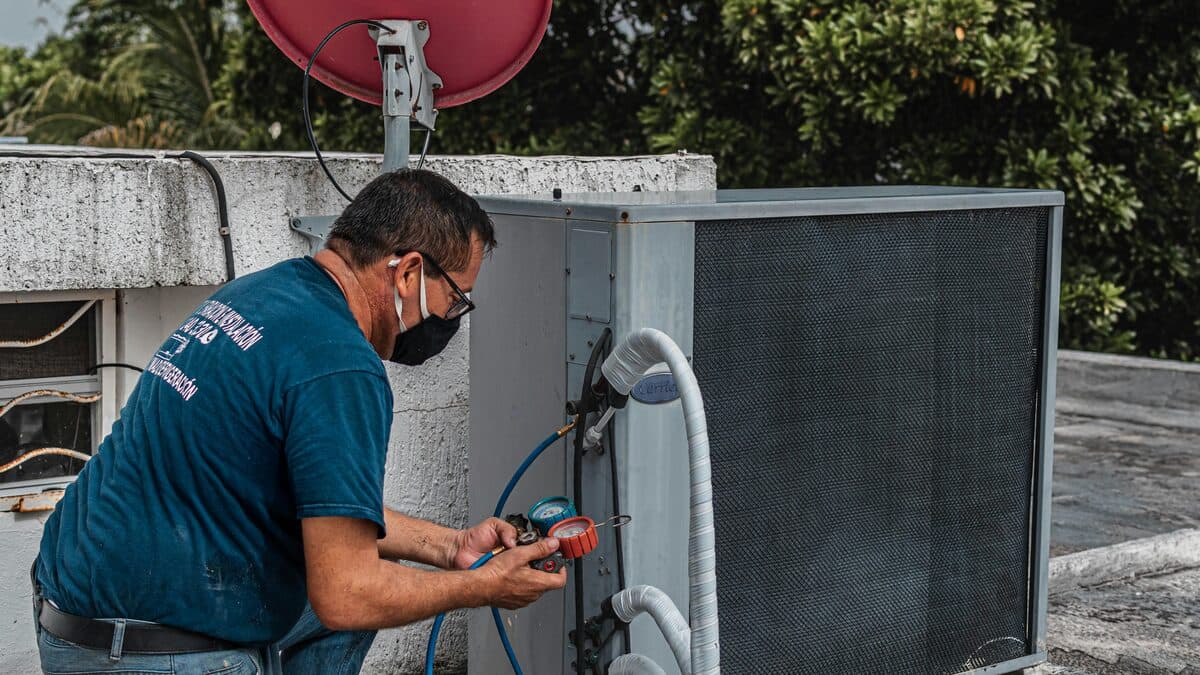
What you can't do—and shouldn't try—is check or add refrigerant yourself. Handling refrigerant requires EPA certification, and diagnosing a refrigerant issue accurately requires gauges and training. Guessing and adding refrigerant to an already properly charged system can damage the compressor. This is one of those jobs that genuinely requires a professional.
When to Call PULSE HVAC
Call us if you notice any combination of the signs above, especially warm air from vents, ice on the lines, or an AC that runs continuously without cooling your home down. These aren't issues that improve on their own.
You should also call if:
- Your system wasn't cooling well at the end of last summer and you haven't had it looked at since
- You hear hissing or bubbling near either your indoor or outdoor unit
- Your energy bills are higher than expected for this time of year
- It's been more than two years since your last AC inspection and you're heading into a Sacramento summer
A refrigerant check is part of a standard AC tune-up. Our technicians will check the system pressure, look for signs of leaks, inspect the coils and connections, and give you an honest assessment of where things stand. If there is a leak, we'll find it and explain your repair options clearly before doing anything.
We serve homeowners throughout Sacramento, Carmichael, Roseville, Fair Oaks, Rancho Cordova, Elk Grove, and the surrounding areas—and April is genuinely one of our best appointment windows before the summer rush hits.
Don't Wait Until July to Find Out
Every summer, we get calls from homeowners in Folsom and Elk Grove who are dealing with a failed AC in 105-degree heat, wishing they'd scheduled service back in spring. Refrigerant issues caught in April are usually straightforward repairs. The same problem left until the middle of a heat wave can mean compressor damage, longer wait times, and a much bigger bill.
If your AC felt off last summer, or if it hasn't been serviced recently, spring is the time to act.
Call PULSE HVAC at (916) 850-2221 or book your appointment online at /book. A quick inspection now can save you a lot of grief when Sacramento's real heat arrives.
Sources
Need HVAC help in Sacramento?
Same-day service · Free estimates · Licensed & insured