
Reviewed by Paul R., CEO & Installer
An outdoor AC that hums and never starts is often a failed run capacitor — not a compressor you have to replace today. It can also be a contactor or relay humming with no power reaching either motor. When the capacitor is the fault, the motor is getting power and cannot overcome the can that should give it a starting kick. You hear a hum, sometimes a click, and the fan sits still while the house in Sacramento climbs.
This is the sibling of AC condenser fan motor failing signs. Same outdoor box. Different part. People who search ac capacitor replacement or condenser fan troubleshooting are usually hearing this hum.
What the hum actually is
The compressor and the condenser fan both need a run capacitor. A dual can (for example 35/5 MFD 440V) feeds both. When the dielectric dries out, the motor hums, the shaft does not turn, and a thermal overload eventually clicks it off. From the yard it sounds like the unit is “trying.”
A tech with the power off can tell these apart: a fan that turns freely while the compressor hummed is usually a weak capacitor; a blade that is locked in place is seized fan-motor bearings, not a dead compressor. Do not spin the fan on a live disconnect. Only a meter decides.
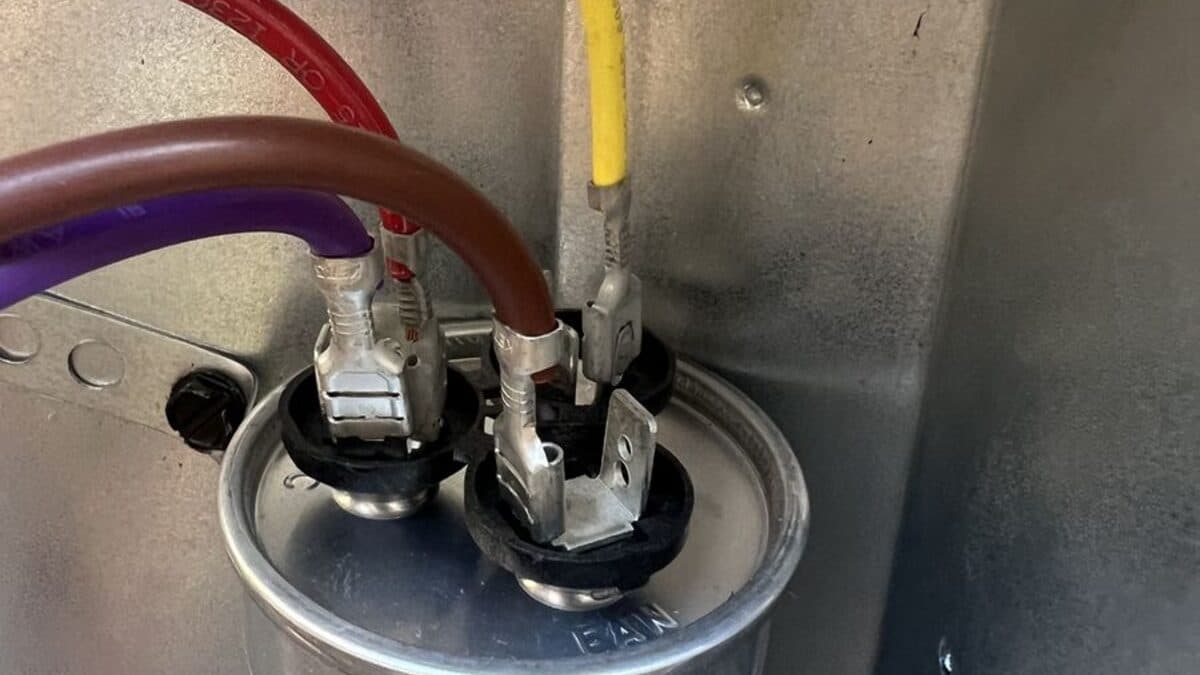
On 30 July 2026 we replaced a 35/5 MFD 440V dual run capacitor on a Sacramento condenser whose compressor would not start. Fan, herm, and common leads went back on a new can. The system ran. That job is the photo on this page.
What not to do
Do not stick a screwdriver across the terminals. The capacitor holds a charge after you shut the breaker. Do not keep resetting a tripped breaker. Do not “spin the fan with a stick” on a live disconnect. Those are how people get hurt and how compressors get buried.
Shut the thermostat off if the hum continues without the fan starting. A locked rotor overheats windings.
A five-minute check that is actually safe
Confirm cool, fan auto. Look at the outdoor disconnect and the breaker. If a breaker retrips immediately, leave it off. A shorted capacitor can do that; so can grounded compressor windings. Do not keep resetting.
Do not open the electrical panel to hunt for a bulged can. Book AC repair. A licensed tech opens that cover, discharges the capacitor, measures microfarads against the label, and replaces a dual run capacitor on the truck when the rating matches. Wrong microfarads kill a compressor that was still good.
If the capacitor tests in spec and the fan still will not spin, you are in the condenser fan motor diagnosis, not this one.
Why Sacramento heat kills these cans
The capacitor lives in a metal box that runs near-continuous on 100°F+ afternoons. Age plus heat dries the dielectric. Units that hummed through June often fail on the first 105°F day in July. ENERGY STAR maintenance will not save a can that has already bulged, but a clean coil and a living filter keep the motor from asking the capacitor to work even harder.
When to call PULSE HVAC
Call the same day if the outdoor unit hums, the fan is still, or you already smell a hot-electrical odor at the condenser. We carry common dual run capacitors, we discharge before we measure, and we will not quote a compressor until testing confirms it has failed — open, locked, or grounded windings, not only an open winding.
Book online or call (916) 850-2221. Same-day in the Sacramento area during 8 AM–8 PM hours — not a 24-hour shop, and not a DIY capacitor.
Sources
Need HVAC help in Sacramento?
Same-day service · Free estimates · Licensed & insured