
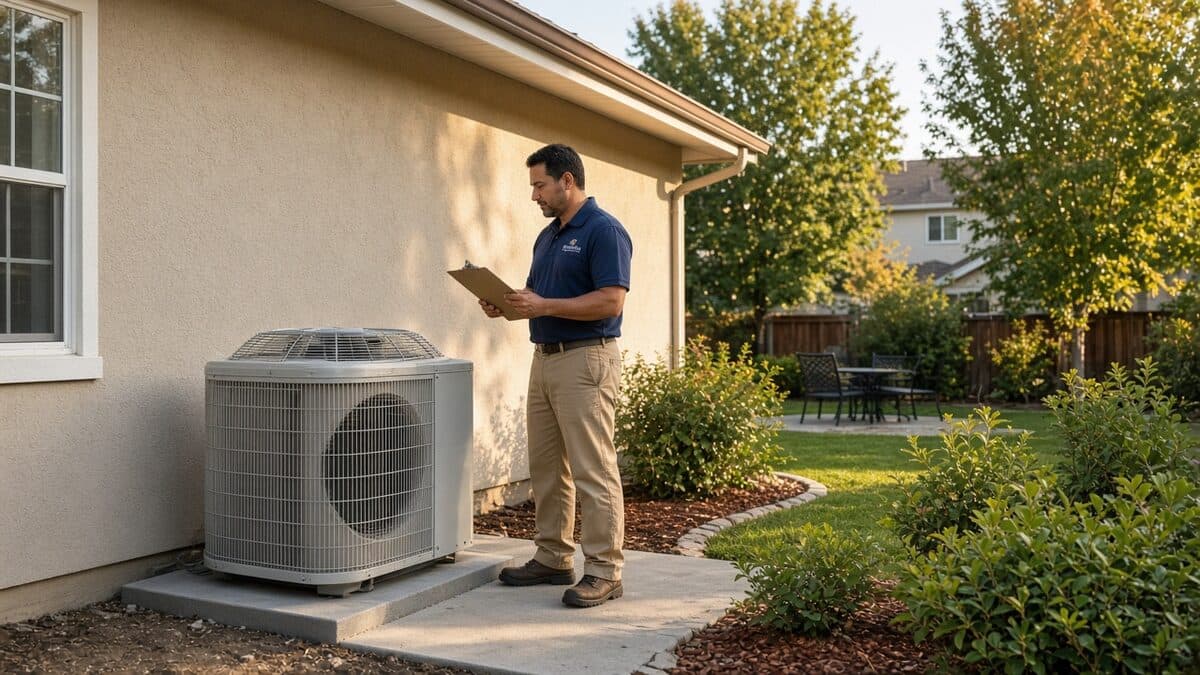
Reviewed by Alex J., Lead HVAC Technician, NATE Certified
September 2026 daytime highs in Sacramento still sit in the low 90s, even after the Delta breeze cools nights. That does not mean the system recovered from summer load. ENERGY STAR recommends checking or changing the cooling-season filter every one to three months; restricted return air is what we find when a unit short-cycles after a 100-degree streak, then looks “fine” on a 68-degree night.
A late spike still puts the condenser on 90-degree days, and that is when dispatch fills first. Skip the wait-and-see. Schedule service while the tech can still test under load. Same-day only if the house cannot cool or ice covers the coil. If you smell burning, shut the system off at the breaker. If you see smoke, leave the home and call 911. Otherwise a planned window is calmer than calling the morning the inversion traps heat again.
Why cooler nights are the wrong signal
Cooler nights hide summer damage; they do not reverse it. Compressors, capacitors, and contactors take the hit on long run times, not at 2 a.m. when the thermostat is satisfied. Valley heat still returns in September. Daytime highs in the low 90s are enough to expose a weak start capacitor that sailed through a mild evening.
We opened a 2009 split system last September in a 1970s tract house east of the river. The owner thought the job could wait because bedrooms were comfortable after 10 p.m. Filter had not been changed since the last sale. Coil was matted, the outdoor fan was dragging, and the unit could not hold setpoint once the afternoon sun hit the west wall. That is the pattern: nights feel recovered, days do not.
If a repair quote later approaches a large share of replacement, compare remaining life and efficiency before you approve another patch. Age near the end of typical service life, repeated major repairs, or failure to keep up on 90-degree days after service are the replacement triggers. Do not guess a sticker price online. Repair cost depends on the failed part, refrigerant work, and labor time. A licensed tech diagnoses first, then quotes before work. Ask for a written estimate and a CSLB license check. Budget for diagnosis plus parts.
What a September visit actually checks
A September visit is how you catch a weak capacitor or a load-only fault: the tech tests under real afternoon heat, not a cool-morning idle. That is the point of booking while highs are still in the 90s. The tech can watch superheat and subcooling, confirm the condenser is rejecting heat, and catch a contactor that chatters only when the unit has been running hard.
Air conditioning in Sacramento still works against SMUD summer peak windows. Review current SMUD rate schedules so you know when a struggling unit is also the most expensive to run. A set window usually costs less chaos than waiting for the first fall spike, when neighbors call at once.
Skip annual duct cleaning unless you have had rodents or a remodel. It rarely changes airflow enough to notice compared with a clogged filter and a dirty coil. Fix the restriction first.
When to Call PULSE HVAC
Call PULSE HVAC when the home still needs cooling on 90-degree September days, when you want a scheduled diagnosis instead of a panic dispatch, or when a prior “it ran last night” excuse no longer holds. Use same-day if the house cannot cool or ice covers the coil. If you smell burning, shut the system off at the breaker before you call. If you see smoke, evacuate and call 911—do not leave the equipment running. Otherwise schedule now so the visit happens under load.
Have the filter size written down. Note whether the outdoor unit ices or the breaker trips. That cuts diagnosis time. Do not approve work without a written estimate and a license check on cslb.ca.gov.
Same-day versus a scheduled window
Use same-day only for no-cool or a frozen coil; otherwise schedule a planned visit while highs remain in the 90s. A scheduled window lets the technician arrive when the house is actually asking for cooling. Morning-only slots in a mild week miss the fault.
Take the trade-off: you give up the fantasy of “maybe it is done for the year” and you keep the system from failing the first afternoon a late heat wave returns. Folsom, Roseville, and the rest of the Sacramento area see the same Valley spike pattern. Book the repair while September can still prove the repair.
PULSE HVAC can take the call at (916) 850-2221, or book online at /book for a September window before the next heat spike.
Sources
Need HVAC help in Sacramento?
Same-day service · Free estimates · Licensed & insured