
Reviewed by Paul R., CEO & Installer
When your AC's evaporator coil freezes in the middle of a 100°F heat wave, there are two usual causes: too little warm air moving across the coil, or too little refrigerant in the system. Either one lets the coil run below freezing, and the moisture it pulls out of your house turns to ice. The fix starts the same way for both. Shut the cooling off and let it thaw.
It sounds backward that an AC freezes on the hottest days. Long run times are the reason, and this is when the system is working hardest: ENERGY STAR estimates that as much as half of the energy used in a typical home goes to heating and cooling. A system that cycles on and off in May runs for hours straight during a late-season heat wave, and a small airflow or charge problem that never showed up in spring has time to build a sheet of ice.
Symptoms of a Frozen Evaporator Coil
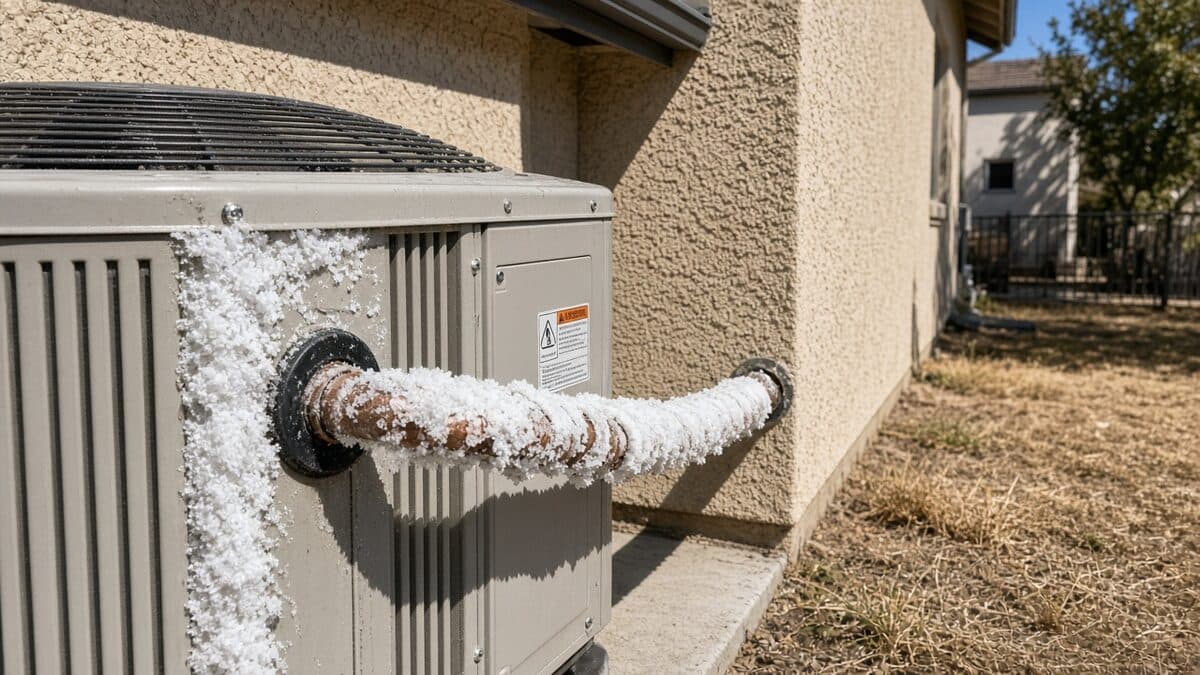
The clearest symptom is warm or weak air from the vents while the system runs nonstop. Walk outside and look at the large insulated copper line going into the outdoor unit. Frost or ice on that line, or on the fitting where it enters the cabinet, confirms it.
Other signs show up indoors. Water around the furnace or air handler as the ice melts. A house that keeps climbing toward 85°F through the afternoon even though the outdoor unit sounds normal. Sometimes you can see frost on the coil through the access panel, but most homeowners never need to open anything to know.
How to Thaw a Frozen AC Safely
Turn the cooling off at the thermostat and set the fan to on. The blower pushes warm indoor air across the coil and melts the ice far faster than letting it sit.
Plan on at least a couple of hours. A coil that has turned into a solid block of ice can take most of a day. While it thaws:
- Put towels around the indoor unit. Melting ice can overflow the drain pan, especially in attic and closet installations.
- Never chip at the ice. The coil fins and tubing are thin aluminum and copper, and one puncture turns a thaw into a refrigerant leak.
- Skip the hair dryer and heat gun. Direct heat on refrigerant lines and a wet electrical cabinet is a bad combination.
- Wait for all of it to melt. Restarting cooling while ice is still on the coil can send liquid refrigerant back to the compressor, which is how a cheap problem becomes an expensive one.
Once the suction line at the outdoor unit is dry and the indoor coil is clear, you are ready to look for the cause.
Airflow Problems You Can Check Yourself
Restricted airflow is the cause you can often fix yourself, and it is the first thing to rule out. Check these before you restart cooling:
- The filter. A loaded filter is the most common reason a coil ices. ENERGY STAR recommends checking it every month during heavy use and changing it at least every three months. After a summer of smoke and long run times, many filters are overdue.
- Supply registers. Closing vents in unused rooms raises resistance across the whole system. Open all of them.
- Return grilles. Furniture, boxes or a rug pushed against a return starves the coil of air.
- The blower. With the fan on, the air from the vents should be strong and steady. A blower that sounds sluggish, or barely moves air, points to a failing motor or capacitor.
A dirty indoor coil restricts airflow the same way a clogged filter does, but it sits behind the filter where you cannot easily reach it. A coil that has run for years behind cheap or missing filters is a common reason a clean filter does not solve the problem.
Then restart cooling and watch it for the rest of the day. If the air turns cold and the big copper line at the outdoor unit sweats but stays free of frost, airflow was the problem and you are done.
When the Coil Freezes Again, Call a Technician
A coil that ices again within a day, with a clean filter, every vent open and a strong blower, usually means low refrigerant or a dirty indoor coil, and both need a technician. When the charge is low, the pressure in the evaporator drops and the coil runs colder than it was designed to. Refrigerant does not get used up, so unless the system was undercharged when it was installed, low refrigerant means a leak.
Our position: do not pay for a refrigerant top-off without a leak search. Adding refrigerant to a leaking system buys a few weeks at best, and you pay for the same refrigerant again the next time it freezes. The EPA's Section 608 rules require certified technicians for refrigerant work. A proper repair finds the leak, fixes it, pressure-tests the system and then charges it to the manufacturer's specification.
That is how we handled a Sacramento refrigerant leak repair we documented in July: the leak was at a fitting on the line set, and the fix was to braze the joint and pressure-test the system before recharging. Leaks at line-set fittings and flare connections are common, and a slow leak of that kind is one of the ways a system ends up low enough to freeze during a long heat wave.
A Typical Heat-Wave Freeze
In a typical heat-wave freeze, the filter decides whether it is a quick fix or a leak search. Picture an Elk Grove two-story from the early 2000s, the air handler in the attic, and the thermostat set to 72°F through a stretch of 100°F afternoons. The system has run since late morning without shutting off. By late afternoon the upstairs is warmer than when it started, and there is a white crust of ice on the suction line beside the condenser.
If the filter is gray and bowed, a new filter and a few hours of thawing often solve it. If the filter is clean, plan on a technician checking the indoor coil and the refrigerant charge.
When to Call PULSE HVAC
Call us if the coil freezes again after you have thawed it and changed the filter, if water from the thaw is dripping through a ceiling below an attic unit, if the blower barely moves air, or if you have been told to add refrigerant more than once. Those point to a leak, a failing blower or a drain problem, and each needs a technician with gauges on the system.
PULSE HVAC serves homeowners across the Sacramento area. Call (916) 850-2221 or book online, and we will find why the coil froze instead of just melting the ice.
Sources
Need HVAC help in Sacramento?
Same-day service · Free estimates · Licensed & insured