Reviewed by Paul R., CEO & Installer
Why is my AC not cooling on the days you need it most? If your system holds a comfortable 74°F when it's 90°F outside but starts drifting to 78°F, 80°F, or higher once the thermometer hits 103°F, you're not imagining it — and your AC probably isn't broken. What you're feeling is physics colliding with a Sacramento heat wave. Here's exactly why it happens, and what you can do about it right now.
Your AC Has a Design Limit — and July Finds It
Every central air conditioner is engineered to cool your home across a specific range of outdoor temperatures. Most residential systems in the Sacramento area are sized to pull your indoor temperature down by roughly 20 degrees below whatever it is outside. On a 90°F afternoon, that math works fine: the system can deliver mid-70s indoors without straining.
Push the outdoor temperature to 103°F, though, and that same 20-degree spread only gets you to the low 80s at the equipment's limit. Your AC is still running. It's still producing cold air. It simply can't move enough heat out of your house to overcome the combined thermal load — sun beating on the roof, hot air leaking in, and an outdoor coil trying to dump heat into air that's already scorching.
The Condenser Coil Is the Bottleneck
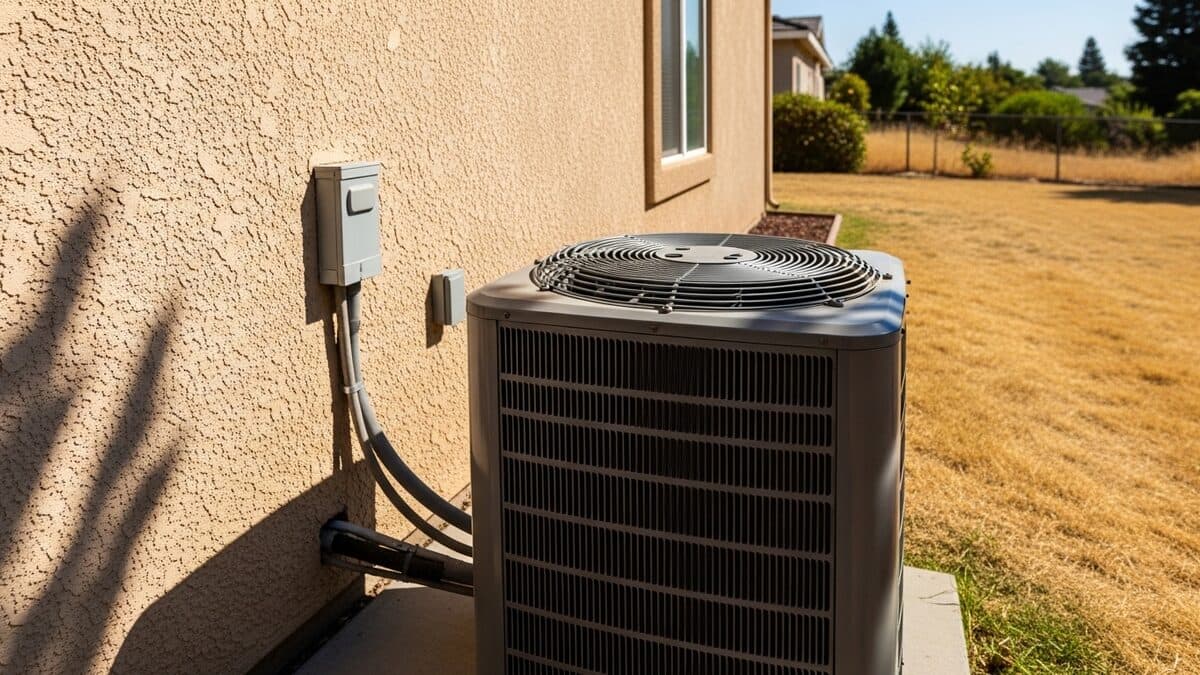
The outdoor unit — the condenser — is where your AC releases all the heat it pulled from inside. It does that by blowing outdoor air across a coil full of hot refrigerant. The bigger the temperature difference between that refrigerant and the outdoor air, the faster heat moves.
When it's 103°F outside, that temperature difference shrinks. Heat rejection slows down. Refrigerant pressures climb higher and higher, the compressor works harder for less result, and cooling capacity drops right when you need it most. The U.S. Department of Energy notes that a clean, well-maintained system runs more efficiently — and on extreme days, that margin is the difference between keeping up and falling behind.
This is why a dirty condenser coil hurts so much in a heat wave. If the coil is coated in cottonwood fluff, dust, or grass clippings — common across Carmichael, Citrus Heights, and Fair Oaks yards in July — it can't reject heat efficiently even on a mild day. Add 103°F ambient air on top of that restriction and the system simply chokes.
What You Can Actually Check Right Now
Before you assume the worst, walk through these quick, safe steps. Any one of them can restore meaningful comfort during a heat wave.
Check your air filter first. A clogged filter chokes airflow across the indoor coil, and reduced airflow means reduced cooling — full stop. This is a free two-minute fix. If it's gray and matted, swap it. You'll often feel stronger, colder airflow from the vents within minutes.
Clear the outdoor unit. Shut the system off at the thermostat, then gently rinse the outdoor coil with a garden hose from the inside out if you can reach it, or just clear leaves, weeds, and debris away from all sides. Give it at least two feet of breathing room. Don't use a pressure washer — you'll bend the delicate fins.
Close blinds and reduce internal heat. SMUD's Beat the Heat tips recommend blocking direct sun and easing the load on your system during peak afternoon hours. Every degree of solar heat you keep out is a degree your struggling AC doesn't have to fight.
Set realistic expectations for the thermostat. Cranking it to 68°F on a 103°F day won't make the system cool faster — it'll just run nonstop and never reach the target. Set a temperature the equipment can actually hold and let it maintain that.
When Reduced Cooling Becomes a Real Problem
There's an important difference between less-cold air and warm air. Reduced cooling during a heat wave is normal physics. But if your vents are blowing genuinely warm air, that's not a heat-wave symptom — that usually points to a refrigerant problem, a failed compressor, or another mechanical fault that needs an HVAC technician. Sacramento AC repair for warm-air complaints is a diagnosis, not a DIY.
Likewise, if your AC won't turn on at all during a heat wave, the grid may be part of the story. High demand across the Sacramento area can cause voltage sags that keep compressors from starting, and built-in high-pressure safety switches will shut a unit down when refrigerant pressures spike past safe limits. Let the unit rest in the shade for about 30 minutes, then try again.
Is It Time to Repair or Replace?
If your system is keeping up at 90°F and only falls behind at 103°F, that's rarely a reason to replace it. But if it's failing on ordinary days too, running R-22 refrigerant, or over 15 years old, replacement may make more sense than another repair. A common industry guideline is the 5,000 rule: multiply the repair cost by the unit's age in years, and if the result tops $5,000, replacement usually wins. Newer, higher-efficiency systems — the kind ENERGY STAR certifies — also hold up better against extreme heat. A yearly Sacramento AC tune up is the cheapest way to protect the capacity you already have.
When to Call PULSE HVAC
Call us when the basics don't cut it. Specifically, reach out if:
- Your vents are blowing warm — not just less-cold — air
- The system won't restart after a 30-minute rest
- You hear grinding, buzzing, or the outdoor fan isn't spinning
- Water is pooling around the indoor unit
- The house never recovers, even on a mild 88°F evening
These point to refrigerant, compressor, electrical, or drainage issues that need professional Sacramento AC service. We work across Sacramento, Roseville, Folsom, Elk Grove, Rancho Cordova, Carmichael, Citrus Heights, and Fair Oaks, and we'll tell you honestly whether you need a quick fix or a bigger conversation about replacement.
Don't spend the next heat wave sweating it out. If your AC is falling behind and the DIY checks haven't helped, the team at PULSE HVAC is ready to help. Call us at (916) 850-2221 or book online anytime at /book — we'll get your comfort back on track.
Sources
Need HVAC help in Sacramento?
Same-day service · Free estimates · Licensed & insured