Reviewed by Paul R., CEO & Installer
Why Is My Furnace Blowing Cold Air? Start Here
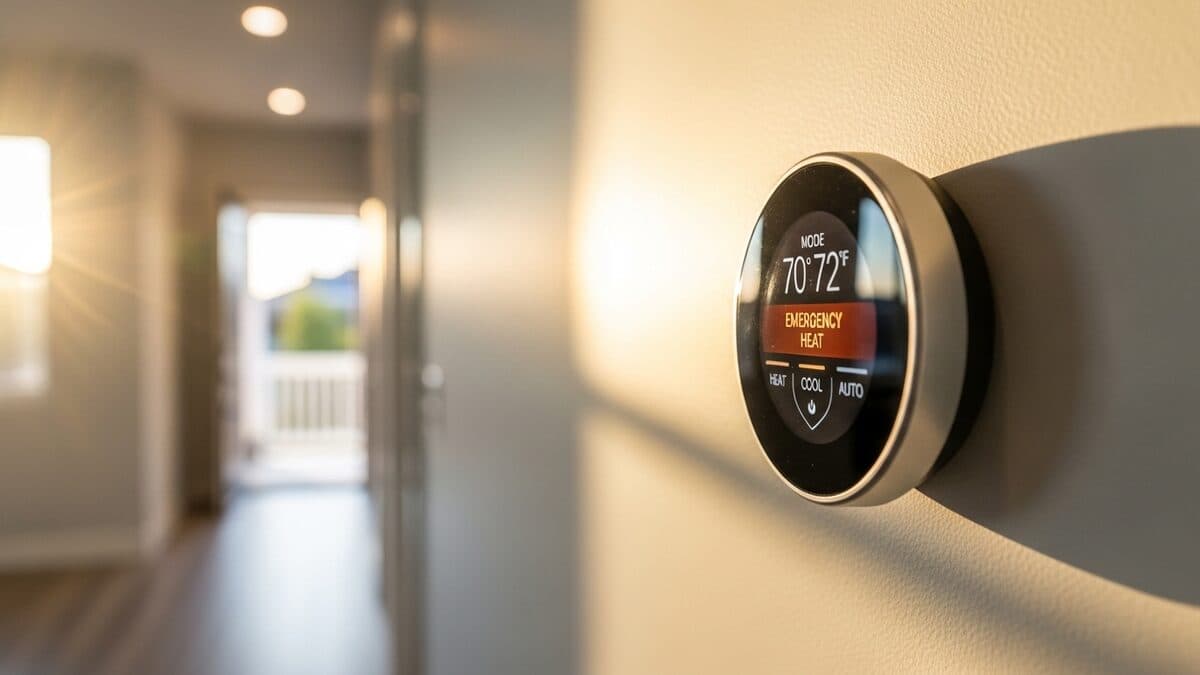
If you searched "why is my furnace blowing cold air" and landed on your thermostat's Emergency Heat setting, stop before you flip that switch. It's one of the most misunderstood buttons on a heat pump system, and using it wrong — or leaving it on — can quietly run up your SMUD or PG&E bill without fixing the actual problem.
Here in the Sacramento area, most homes with heat pumps see that "EM Heat" label year-round and never touch it. That's usually the right instinct. This post explains exactly what emergency heat mode does, why triggering it in July makes no sense, and which symptoms mean it's time to call a technician instead of guessing at your thermostat.
What Emergency Heat Mode Actually Does
A heat pump heats your home by moving heat from the outdoor air indoors, using the outdoor compressor unit. That's the efficient part of the system. According to the U.S. Department of Energy, heat pumps can deliver two to three times more heat energy than the electricity they consume — which is why they're a smart fit for our mild Sacramento winters.
Emergency heat mode shuts that outdoor unit off completely. Instead of moving heat, your system falls back on backup heating — usually electric resistance strips or, in some setups, a gas furnace. These backups make heat the hard way, and they cost more to run for the same warmth.
That's the key point: emergency heat is a fallback, not an upgrade. It exists so you're not left in the cold if the outdoor unit physically fails. It is not a "heat harder" button, and it won't make your home warmer faster on a normal cold day.
Why Running It in Summer Wastes Money
It's July 2026, and if you're reading this because your system is "blowing cold air," here's the good news: in summer, cold air is exactly what you want. Your heat pump is running in cooling mode. There is no reason to touch emergency heat right now — it's a heating-only function.
If you accidentally switched your thermostat to EM Heat during summer, you could end up with the system trying to run backup heating strips while you're trying to stay cool, or simply not cooling correctly. Either way, you're paying for something that doesn't help. Set the thermostat back to Cool and let the heat pump do its normal job.
The broader lesson holds in every season: leaving emergency heat engaged when the outdoor unit is perfectly fine bypasses the most efficient part of your system for no reason. Do that for days or weeks and the extra cost shows up on your utility bill. SMUD's home heating and cooling guidance is a good resource for understanding how your equipment choices affect what you pay.
When Emergency Heat Is Actually the Right Call
There's a narrow set of situations where EM heat earns its name. Use it only when:
- Your outdoor unit is visibly damaged or physically broken.
- The outdoor unit is producing no heat at all despite running normally.
- A technician has confirmed the compressor has failed and told you to run backup heat until repairs are done.
A severe ice storm can also knock an outdoor unit out of service — though that's rare in the Sacramento area. In that specific scenario, emergency heat keeps your home warm temporarily while you arrange a repair.
Notice what's not on that list: an ordinary cold morning in Carmichael or Folsom. Your heat pump is designed to handle those automatically, and it does so far more efficiently than backup heat ever could. If it's simply chilly outside, leave the thermostat on regular heat and let the system work.
The Real Reasons a Heat Pump Struggles to Heat
When homeowners in Elk Grove, Roseville, or Rancho Cordova tell us their heat pump "isn't heating right," emergency heat is almost never the fix — because the root cause is usually something else entirely. In our climate, the common culprits are:
- A dirty air filter choking airflow.
- A refrigerant leak reducing the system's capacity.
- A failing reversing valve, the component that switches between heating and cooling.
- Ice buildup on the outdoor coil blocking airflow.
Every one of these is a maintenance or repair issue. Switching to emergency heat doesn't solve any of them — it just hides the symptom while the underlying fault gets worse. A dirty filter is a five-minute fix; a neglected refrigerant leak or a failing valve is not. Masking the problem with EM heat can turn a smaller repair into a larger one.
How to Tell the Difference: Fault vs. False Alarm
Before you assume the worst, run through a quick check:
- Is the thermostat set correctly? Confirm it's on Heat (or Cool, in summer) and not accidentally on EM Heat.
- When did you last change the filter? A clogged filter is the most common cause of weak airflow and poor performance.
- Look at the outdoor unit. Is it running? Is it iced over, blocked by debris, or making unusual noise?
- Is air moving but not warming? That points to a system fault, not a thermostat setting.
If the basics check out and the system still can't heat, that's your signal to bring in a professional rather than leaving the system on backup heat indefinitely.
When to Call PULSE HVAC
Call a technician — don't just switch to emergency heat — if you notice any of these:
- The heat pump is blowing air but producing no heat.
- You hear grinding or hissing from the outdoor unit.
- The system short-cycles (turns on and off repeatedly).
- Emergency heat itself fails to warm the home.
These symptoms point to a real mechanical problem — a failing compressor, a refrigerant leak, or a reversing valve issue — that needs a proper diagnosis. ENERGY STAR's heat pump resources reinforce that a well-maintained system runs efficiently; leaving a fault unaddressed does the opposite. Getting it fixed early keeps repair costs down and your efficiency where it should be.
PULSE HVAC serves Sacramento, Carmichael, Roseville, Citrus Heights, Folsom, Elk Grove, Rancho Cordova, and Fair Oaks. If your heat pump isn't behaving — in any season — don't gamble with the emergency heat switch. Call us at (916) 850-2221 or book online at /book, and we'll diagnose the real issue.
Sources
Need HVAC help in Sacramento?
Same-day service · Free estimates · Licensed & insured