
Reviewed by Paul R., CEO & Installer
When your HVAC is not working after a power outage, the cause is usually small: a thermostat that reset, a breaker that tripped when the power came back, a furnace that locked itself out, or a compressor waiting out its restart delay. Winter storms knock out power across the Sacramento area every year, and the first cold morning after the lights come back is when people find out. Heating and cooling is the biggest energy job in most homes, as much as half of the energy used according to ENERGY STAR, so it is also the system you most want running again quickly.
Work through the checks below in order. Most systems are back on before you would reach the phone.
Start at the Thermostat
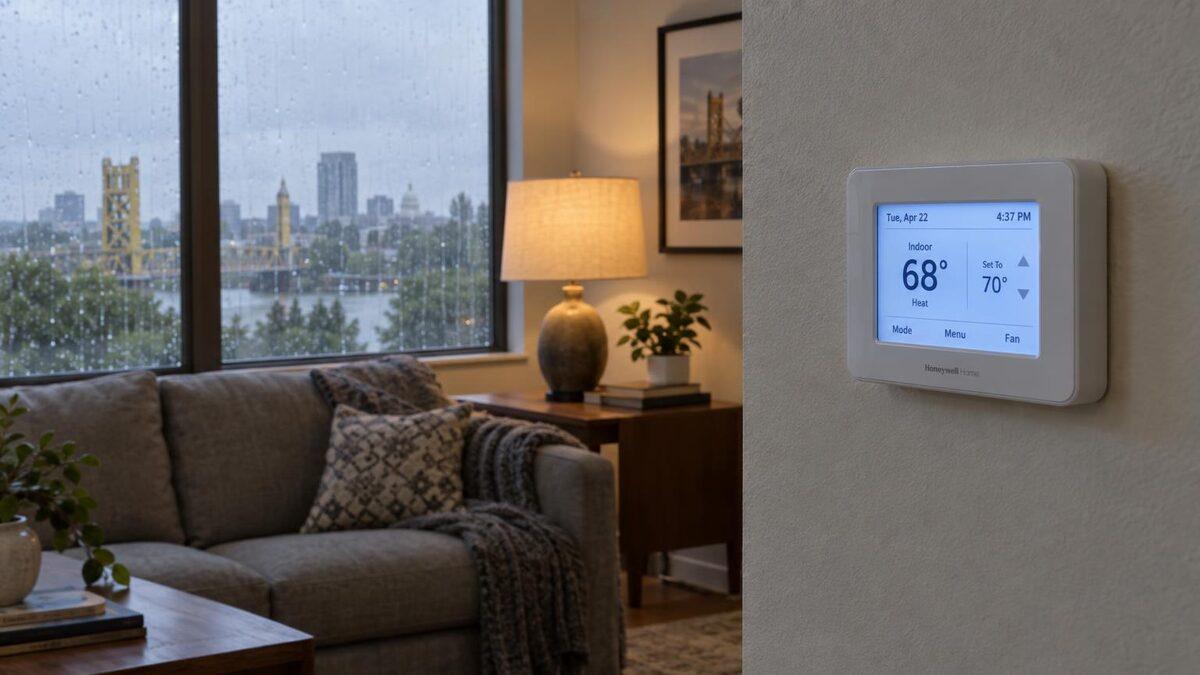
The thermostat comes first, because it is the most common reason the system stays quiet after an outage. Many thermostats restart in a default state: mode set to off, schedule lost, or the clock reset so the "away" setting is running at the wrong time.
Look at three things. Is the screen on? Is the mode set to heat or cool? Is the setpoint a few degrees above the room temperature for heat, or below it for cooling? Smart thermostats can take a minute or two to reboot and reconnect to Wi-Fi, so give them a moment.
A blank screen means the thermostat has no power. Battery thermostats need fresh batteries. Thermostats powered by the furnace go blank when the furnace itself has no power, which points to the next two checks.
Check the Breaker and the Furnace Switch
Check the breaker panel next. Power that comes back after a storm can return unevenly, and a tripped HVAC breaker is quick to rule out. Look for a breaker that sits in the middle position or is flipped toward off, then push it fully off and back on. Most homes have one breaker for the furnace or air handler and a separate, larger one for the outdoor unit.
If the breaker trips again after one reset, leave it off and call a technician.
Then find the furnace service switch. It usually looks like a light switch on the wall or ceiling near the furnace, in the garage, hall closet or attic. Make sure it is on. If it already is, turn it off for about a minute and back on. That clears a lockout, which many furnaces enter after a few failed starts, something that happens easily when power flickers on and off during a storm.
Give the Compressor Its Delay
Give an air conditioner or heat pump a few minutes before deciding it is broken. Most have a built-in delay that keeps the compressor from restarting the instant power returns, which protects it from starting against high pressure. Set the thermostat, then wait several minutes. The indoor blower may start right away while the outdoor unit stays quiet for a bit. That is normal.
Let a Heat Pump Warm Up After a Long Outage
After a long outage in cold weather, a heat pump deserves a little patience. Many outdoor units have a crankcase heater, a small heater that keeps the compressor's oil warm while the unit sits idle. When the power is out for hours on a cold night, that oil cools down.
Some manufacturers recommend leaving the outdoor unit powered for a few hours before calling for heat after a long outage, so the crankcase heater can warm it back up. Check your unit's manual for its exact guidance. In the meantime, if your system has backup electric heat, the thermostat's emergency heat setting can keep the house warm. Switch back to normal heat once the wait is over, because emergency heat costs more to run.
The U.S. Department of Energy describes heat pumps as moving heat rather than making it, and in winter the outdoor compressor is what moves it. That is why the compressor gets the extra care after a long, cold outage.
What a Storm Can Actually Break
Most post-outage problems clear with the checks above. Some do not, because the storm damaged a part. Power surges and brownouts are hard on electronics and motors.
Here is how it usually looks on a typical post-storm call. The power came back overnight. The thermostat is on and calling for heat, the breakers are fine, and the furnace switch is on. The furnace blower runs, but the outdoor heat pump only hums and its fan never turns. The surge took out the run capacitor, a small part that helps the fan and compressor start. A new capacitor and the system is running again the same visit.
Control boards, capacitors and contactors are the usual casualties. Many furnace control boards also carry a small fuse that a surge can blow, which leaves the thermostat blank even with the breaker and switch on. None of them are things to replace yourself, because they need testing to confirm.
When to Call PULSE HVAC
Call us when the breaker trips again after one reset, when the system still will not start after the thermostat, breaker, switch and a short wait, or when the outdoor unit hums but the fan does not turn. We offer same-day repair across the Sacramento area in most cases, and storms are when we expect these calls.
Call PULSE HVAC at (916) 850-2221 or book a repair online.
Sources
Need HVAC help in Sacramento?
Same-day service · Free estimates · Licensed & insured