Reviewed by Boris L., Commercial HVAC Tech, NATE Certified
Does your HVAC pull in outside air during a fire or smoke event? For some Sacramento-area homes, the answer is yes — and that surprises a lot of homeowners who assume their air conditioner only recirculates the air already inside. If your system has a fresh-air intake, an energy-recovery ventilator, or an economizer, it can quietly draw smoky outdoor air into your living room on the exact days you want it sealed out. Here's how to tell what you have, and how to shut it off when the AQI climbs.
Not Every System Pulls In Outside Air — But Some Do
Let's clear up the biggest misconception first. A basic central AC system recirculates indoor air only. It pulls warm air from your rooms through the return, cools it over the coil, and pushes it back out through the supply vents. No outdoor air enters that loop by design.
But plenty of homes in the Sacramento area aren't running a basic setup. Three common features change the picture:
- A dedicated fresh-air intake pipe — a small secondary duct that deliberately brings a controlled amount of outdoor air into your air handler for ventilation.
- An energy-recovery ventilator (ERV) — a device that swaps stale indoor air for fresh outdoor air while transferring heat between the two streams.
- A commercial-style economizer — a motorized damper that opens to use cool outdoor air for "free cooling" when the weather cooperates.
All three are good things most of the year. Bringing in outside air improves indoor air quality and, in the case of an economizer, can cut compressor runtime on mild evenings. Ventilation matters — that's the whole point of standards like those published by ASHRAE. The problem is that "fresh" outdoor air isn't fresh during a wildfire. On a high-AQI day, that same intake becomes a straw feeding smoke straight into your home.
How to Find Your Fresh-Air Intake
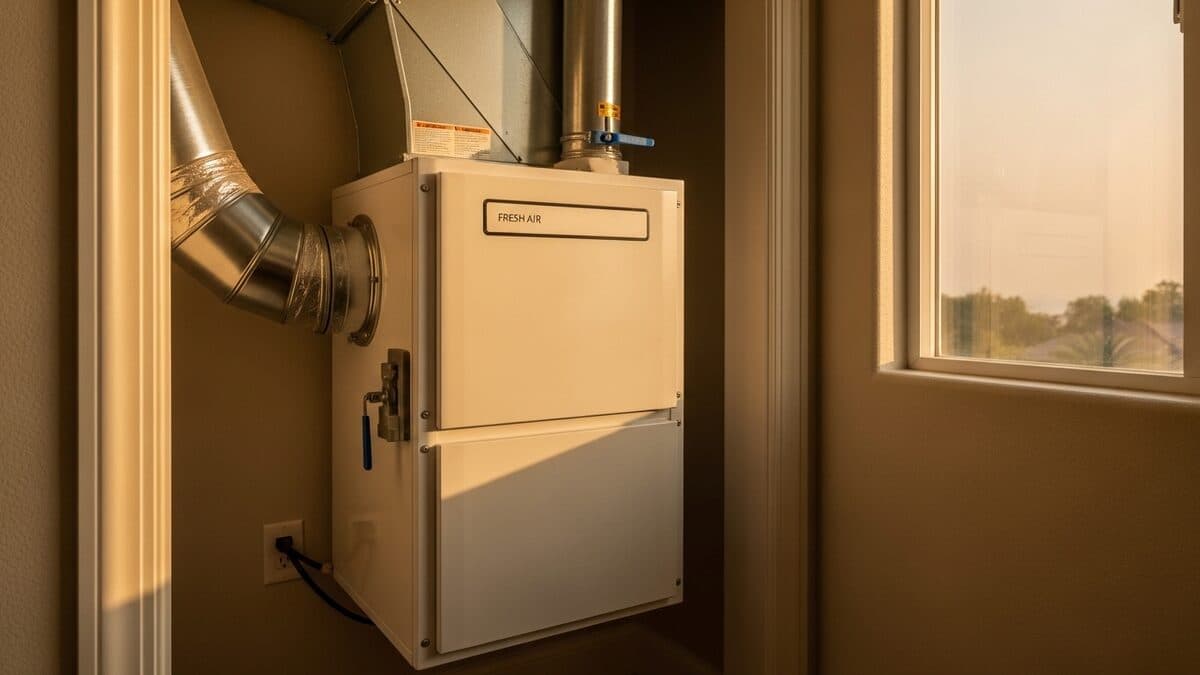
Head to your air handler or furnace — often in a garage, closet, attic, or hallway utility space. You're looking for a secondary duct that's separate from your main supply and return.
Most residential fresh-air intakes are a 4- to 6-inch pipe tapping into the return side of the system. Trace it and you may find it runs to an exterior wall or roof cap. Near where it connects, look for one of two things:
- A manual damper with a small lever on the outside of the duct.
- A motorized actuator — a small boxy motor that opens and closes the damper automatically.
If you have an economizer instead, it's more common in commercial buildings, but some newer high-efficiency systems in Folsom, Roseville, and other parts of the Sacramento area have them. Look for a controller labeled "economizer" near the air handler. If you can't find any secondary duct at all, you likely have a straight recirculating system and nothing to close — good news on a smoky day.
How to Close It During a Smoke Event
Once you've found the intake, closing it is usually simple.
For a manual damper: rotate the lever so it sits perpendicular to the duct. When the handle runs across the pipe rather than along it, the damper blade inside is blocking airflow. Some levers have "open" and "closed" markings stamped right on them.
For a motorized economizer or ERV controller: switch it to "closed" or "recirculation" mode on the controller. This tells the damper to stay shut and keeps your system circulating indoor air only.
If your intake is hard to reach, unlabeled, or you simply aren't sure you're closing the right thing, don't force anything — a qualified tech can do this safely and show you where it is for next time.
Yes, It's Safe to Run AC in Recirculation Mode
A common worry: "If I close off the outside air, is it safe to keep the AC running?" It is. Running your system in full recirculation mode is exactly what the EPA recommends on smoky days. Your system keeps cooling and filtering the air already inside your home — you're just not adding smoke to the mix.
To get the most out of recirculation, pair it with a MERV-13 or higher filter. Higher-MERV filters capture the fine particles that make wildfire smoke so harmful. During a Sacramento summer, when triple-digit heat and smoke often arrive together, being able to run your AC comfortably and keep smoke out is the ideal combination — closed intake plus a good filter gets you there.
When to Reopen the Intake
Sealing the intake is temporary. Fresh-air ventilation is beneficial once the smoke clears, so you'll want to reopen it after conditions improve.
Check AirNow.gov for your local reading before reopening. Aim to wait until your AQI returns to "Good" (0–50), or at minimum "Moderate" (51–100). Air quality across Sacramento, Elk Grove, Citrus Heights, and nearby communities can swing fast after a wind shift — a canyon breeze can clear the valley in hours or fill it back up just as quickly. Confirm the numbers have actually improved rather than guessing from how the sky looks. Once you're in the clear, reverse whatever you did to close the intake: rotate the manual lever back parallel to the duct, or switch the controller off recirculation mode.
When to Call PULSE HVAC
Some situations are worth a professional's hands:
- You can't locate a secondary duct and want to know for certain whether your system pulls in outside air.
- Your intake damper is seized, missing a lever, or the motorized actuator won't respond.
- You have an economizer and aren't sure how to switch it to recirculation.
- You want a MERV-13-compatible filter setup verified so your blower can handle the added resistance.
We serve homeowners across Sacramento, Carmichael, Roseville, Citrus Heights, Folsom, Elk Grove, Rancho Cordova, and Fair Oaks, and we're glad to walk you through your specific system so you're ready before the next smoky stretch.
Wildfire season is here, and you shouldn't have to guess whether your HVAC is helping or hurting your indoor air. If you'd like a hand finding and controlling your fresh-air intake, call PULSE HVAC at (916) 850-2221 or book online at /book. We'll make sure your home stays cool and smoke stays outside where it belongs.
Sources
Need HVAC help in Sacramento?
Same-day service · Free estimates · Licensed & insured