
Reviewed by Paul R., CEO & Installer
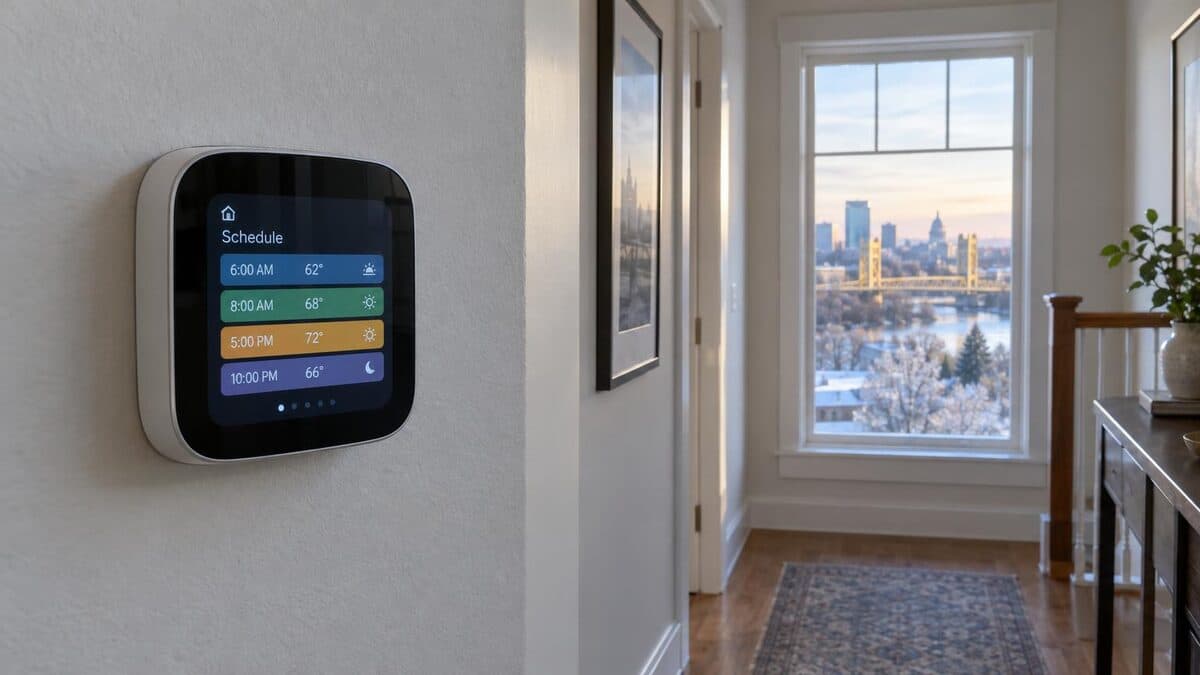
A good programmable thermostat schedule for winter uses four periods: wake, away, home and sleep. Start around 68°F for the hours you are up and home, a few degrees lower for the hours the house is empty and while everyone sleeps, and begin each warm period a little before you need it. With a heat pump, keep the setbacks smaller and start warming earlier. Then live with it for a week before you change anything.
The schedule is where most of a thermostat's savings come from. ENERGY STAR estimates that a certified smart thermostat saves about 8% on heating and cooling bills. A programmable thermostat can get part of that benefit, but only when its schedule matches how the household actually lives. Many never do, because the schedule is left on factory settings or overridden all day.
The Four Periods
Most programmable thermostats offer four periods per day. That is enough for nearly every household.
Wake. The time you get up. Set the comfort temperature, around 68°F, and start this period 30 to 60 minutes before you actually get out of bed, so the house is warm when you are.
Away. The hours the house is empty on a workday. Drop a few degrees. If someone works from home, skip this period on those days or use a smaller drop.
Home. Evening, when everyone is back. Return to the comfort temperature, again starting a bit before people arrive.
Sleep. Bedtime through early morning. Drop a few degrees.
Use a separate weekend schedule if your weekends look different. Most thermostats let you set weekdays and weekends independently, or each day on its own.
Starting Temperatures
These are starting points, not rules. Adjust by one degree at a time after a full week.
| Period | Gas furnace | Heat pump |
|---|---|---|
| Wake | 68°F | 68°F |
| Away | 63°F to 64°F | 65°F to 66°F |
| Home | 68°F | 68°F |
| Sleep | 64°F to 65°F | 65°F to 66°F |
The difference between the two columns is recovery. A gas furnace delivers hot air and climbs back to 68°F quickly, so a deeper setback costs little in comfort. A heat pump warms the house steadily but slowly, so it does better with small setbacks. Our post on heat pump setbacks and AUX heat explains why deep setbacks can bring on the more expensive backup heat strips.
Set It Up for Your Equipment
A schedule only works if the thermostat knows what it is controlling. Check two settings in the installer or equipment menu:
- Equipment type. It should say heat pump if you have one, or furnace if you have gas heat. A thermostat set to the wrong type runs the system poorly.
- Smart or adaptive recovery. Many programmable thermostats can start warming early so the house reaches temperature right at the scheduled time. Turn it on, especially with a heat pump.
Mistakes That Undo the Schedule
The most common way to lose the savings is overriding the schedule all day. Some habits that cause it:
- Cranking the setpoint up to warm faster. A typical single-stage gas furnace heats at the same rate whether you set 70°F or 80°F; it just runs longer and overshoots. With a heat pump, a big jump can also bring on the more expensive backup heat strips.
- A schedule that does not match real life. If you are home at 3 p.m. on Wednesdays, program it, or you will override it every week.
- Permanent hold left on. A hold set for a sick day or a party and never cleared keeps the house at one temperature for weeks.
- Too many periods. Six or eight changes a day are hard to remember and rarely save more than four.
Our position: a simple four-period schedule that everyone in the house agrees on saves more than an aggressive one that gets overridden every afternoon.
Use the Rest of the Toolkit
A schedule pairs well with the other settings covered elsewhere on the blog. For trips of more than a day or two, use vacation mode instead of the regular schedule. If your days vary a lot, geofencing on a smart thermostat can handle the away hours, while the schedule handles wake and sleep.
Keep the system itself in shape too. ENERGY STAR recommends checking the air filter every month during heavy use and changing it at least every three months, since a clogged filter makes every scheduled warm-up take longer.
A Typical Two-Commuter Household
Here is how it usually looks: a Folsom family with two commuters, a gas furnace and a programmable thermostat still on the factory schedule from when it was installed. Someone bumps the heat up every morning at 6 and every evening at 5. Programming wake at 5:30, away at 63°F from 8 to 4:30, home at 68°F and sleep at 64°F from 10:30 usually ends the daily overrides within a week.
When to Call PULSE HVAC
Call us if you are not sure whether your thermostat is set up for a heat pump or a furnace, if the house takes much longer than it should to reach the scheduled temperature, or if you want a smart thermostat installed. Slow recovery is sometimes a setting and sometimes a system that needs service.
PULSE HVAC installs and services thermostats and heating systems across the Sacramento area. Call (916) 850-2221 or book online to schedule a visit.
Sources
Need HVAC help in Sacramento?
Same-day service · Free estimates · Licensed & insured