
Reviewed by Paul R., CEO & Installer
If your heat runs at dawn and your AC runs by mid-afternoon, thermostat auto mode is not broken. It is following setpoints that sit too close together for a late-September day in Sacramento, when the low is 52°F and the high is 94°F. The house slides into the heat setpoint overnight, the sun pushes it past the cool setpoint after lunch, and auto changeover does exactly what you asked.
That flip-flop costs money for no comfort gain. Thermostat settings matter more than most people think: ENERGY STAR puts the savings from a certified smart thermostat at about 8% of heating and cooling bills, and nearly all of that comes from setpoints and schedules, not the hardware.
Why Auto Mode Runs Heat and AC on the Same Day
Auto mode runs heat and AC on the same day because both setpoints are inside the range your house actually reaches. Picture a heat setpoint of 68°F and a cool setpoint of 72°F. With the windows shut, a typical Sacramento house drifts down to the mid-60s by 6 a.m. this time of year. Heat comes on. By 3 p.m., west-facing rooms are past 72°F. Cooling comes on.
What makes fall worse than midsummer is the size of the daily swing. In July the house never gets near a heat setpoint, so auto mode behaves like cool mode. In late September, a 40-degree swing outdoors covers both ends of a narrow band inside.
What the Deadband Does
The deadband is the minimum gap auto mode forces between your heat and cool setpoints, and it is the reason the system cannot heat and cool to the same temperature. Most thermostats set that minimum somewhere around 2 to 5 degrees. Inside the band, the equipment rests.
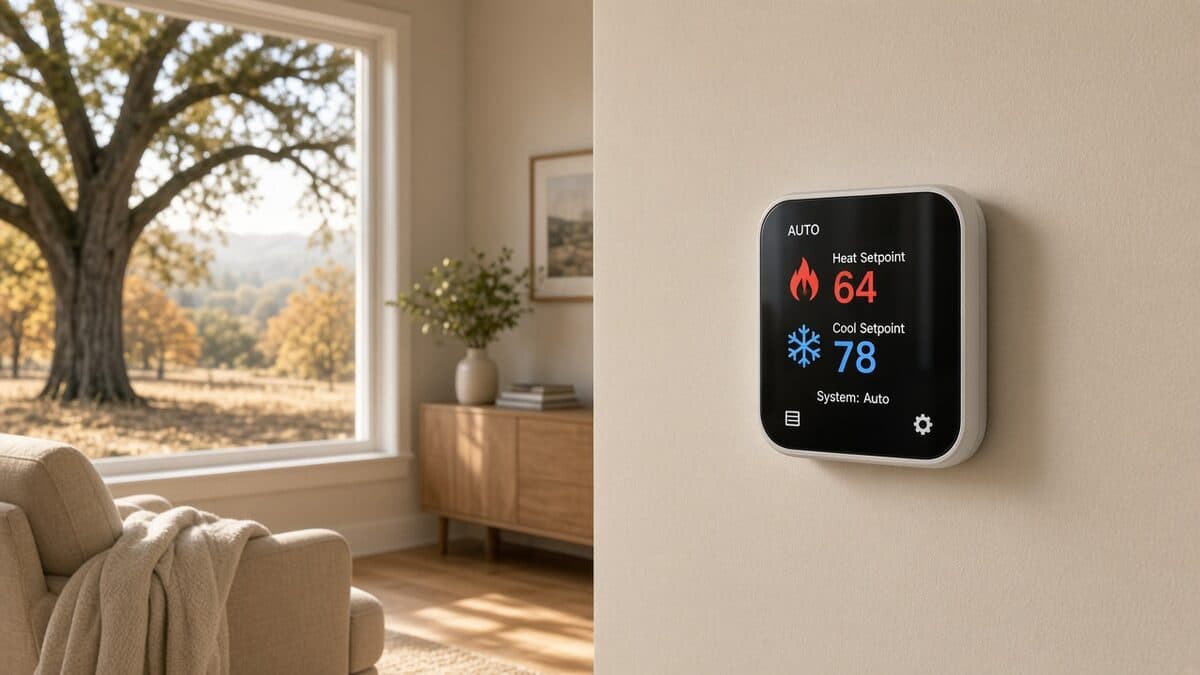
The mistake is treating the minimum as the target. A 3-degree band is legal, but on a fall day it guarantees a changeover. A band of 14 degrees, like 64°F heat and 78°F cool, lets the house coast through a chilly morning and a warm afternoon without either system starting.
Auto mode also waits before switching. Most thermostats hold a changeover delay so the heat cannot fire within minutes of the AC shutting off.
The Settings That Stop the Flip-Flop
The fastest fix is to widen the gap and clean up the schedule. Here is what we set on service calls this time of year:
- Heat setpoint around 64°F. Low enough that a 52°F night will not trigger it in a closed, reasonably insulated house.
- Cool setpoint around 78°F. High enough that a mid-90s afternoon does not start cooling the moment the sun hits the west wall.
- Delete the winter morning entry. Many schedules still carry a 6 a.m. "wake" block at 70°F heat from last January. That single line is the most common cause we find.
- Check every schedule period, not just the current one. Smart thermostats let each period have its own heat and cool pair. One stale period is enough to restart the fight.
SMUD runs time-of-day pricing with its most expensive hours in the late afternoon and early evening, which is exactly when a narrow band kicks the AC on in fall. A 78°F cool setpoint through that window keeps the compressor off during peak pricing on most September days.
Use Cool-Only Instead of Auto Until Nights Stay Cold
Our position: for most Sacramento-area homes, cool-only or off beats auto mode until nights settle into the 40s. Auto mode is a convenience for households that truly want both, like families with an infant or an elderly parent who cannot handle a 63°F morning. For everyone else, it invites a heating cycle the house does not need.
The house stays warm longer than people expect. Attics and walls soak up heat all afternoon and give it back after sunset. Close windows at dusk, and most homes stay above the mid-60s at dawn well into October.
Switch the thermostat from cool to heat when the house drops below the mid-60s by morning on its own, several days in a row. In our area that usually happens in late October or November.
A Folsom Call That Was Not a Repair
We got a call from a Folsom homeowner in a two-story from the late 1990s. The complaint: the furnace ran every morning and the AC ran every afternoon, and the bill looked like July. They were sure something was failing.
The equipment was fine. The thermostat was on auto with a 68°F heat and 72°F cool pair, and the schedule still had a 6 a.m. heat block at 70°F left over from winter. We deleted the winter block and set 64°F and 78°F. The next week, neither system ran more than a handful of times.
No parts. Fifteen minutes of settings.
When Heat and Cool Overlap Points to a Real Problem
Heating and cooling at the same moment is a fault, not a setting. A correctly wired thermostat never calls for both at once. If you feel warm air from the vents while the screen says cooling, the causes worth checking are a failed compressor, a heat pump reversing valve problem, or a wiring fault.
Heat pump owners have one extra wrinkle. A heat pump heats and cools with the same outdoor unit, and the reversing valve shifts it between modes, as the U.S. Department of Energy explains. Frequent auto changeovers cycle that valve more than it needs to. A wider band helps a heat pump even more than a furnace.
Other signs that point to hardware:
- The thermostat shows the right mode, but the equipment does the opposite.
- The screen goes blank or reboots when the system starts.
- The room temperature on the display is several degrees off from a separate thermometer set beside it.
That last one is also the honest answer to when to replace a thermostat in your house. If it reads wrong, loses its schedule, or cannot hold a heat and cool pair at all, a replacement is cheaper than chasing comfort complaints for another season.
When to Call PULSE HVAC
Call us if widening the band and clearing the schedule does not stop the flip-flop, if you feel warm air on a cooling call, or if your heat pump makes a loud whoosh every time it changes modes more than a few times a day. Those point to wiring, controls, or the reversing valve, and they need a technician with meters on the system.
PULSE HVAC serves homeowners across the Sacramento area. Call (916) 850-2221 or book online and we will check the thermostat, the wiring, and the equipment in one visit.
Sources
Need HVAC help in Sacramento?
Same-day service · Free estimates · Licensed & insured