
Reviewed by Paul R., CEO & Installer
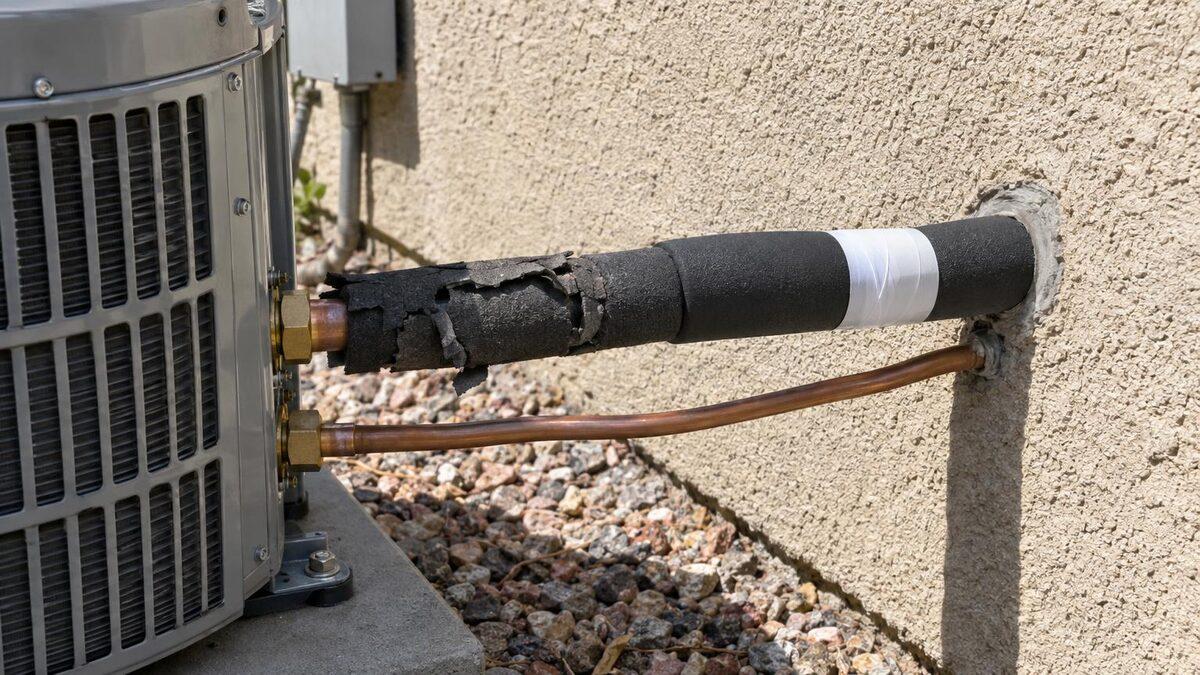
AC line set insulation is the black foam sleeve on the larger copper pipe that runs from your outdoor unit into the house, and when it cracks or falls off, your system loses efficiency every day it runs. In summer that pipe carries cold refrigerant back to the outdoor unit. On a heat pump in winter, the same pipe carries hot refrigerant into the house. Bare copper on a sunny Sacramento wall throws away part of that work. ENERGY STAR estimates that heating and cooling make up as much as half of the energy used in a typical home, so small losses on a system that runs most of the year add up.
The good news is that the outdoor section is easy to inspect and cheap to fix.
What the Line Set Is
An AC line set is the pair of copper refrigerant lines that connects the outdoor unit to the indoor coil above your furnace or in your air handler. You can see them where they leave the outdoor unit and run up the wall or into the ground.
- The large line, called the suction or vapor line, wears the foam insulation.
- The small line, the liquid line, is usually bare on a standard air conditioner.
On a heat pump, the large line does double duty. The U.S. Department of Energy describes heat pumps as moving heat rather than making it, and in heating mode the large line is the one moving hot refrigerant gas to the indoor coil. That is why insulation on a heat pump's line set matters in both seasons.
Why Cracked Insulation Costs You
Cracked or missing insulation costs you in two ways, depending on the season.
In summer, the large line should arrive at the outdoor unit cold. Bare copper picks up heat from the air and the sun along the way, which cuts the system's cooling capacity and makes it run longer on a 100-degree afternoon. Bare cold copper also sweats. That water runs down the wall and stains stucco or drips onto the pad.
In winter, a heat pump pushes hot refrigerant through the same line. Every foot of bare copper outdoors gives some of that heat to the cold air before it ever reaches your house.
Neither loss is dramatic on any single day. Over a year of running, both add up.
Why It Falls Apart in Sacramento
Line set insulation falls apart here mostly because of sun. The standard closed-cell foam is not built to sit in direct ultraviolet light, and on a west- or south-facing wall in the Sacramento valley, unprotected foam turns brittle, cracks and starts to flake off within a few years.
Critters and yard work finish the job. Birds pick at the foam for nesting material, rodents chew it, and string trimmers shred the lowest few inches near the pad.
Here is how it usually looks on a typical tune-up at a 15-year-old system. The foam is intact where it enters the wall and on the shaded side, but the 3 feet facing the afternoon sun is cracked to the copper, and the bottom 6 inches are gone entirely, trimmed off by a weed eater. The fix takes a few minutes and a few dollars in material.
How to Replace It
You can usually replace the outdoor section of line set insulation yourself. The goal is a continuous, sealed sleeve from the outdoor unit to the wall.
- Cut away the damaged foam with a utility knife, working carefully so you do not nick the copper.
- Measure the pipe. Buy closed-cell pipe insulation sized for that diameter, with at least the same wall thickness as the original.
- Install the new sleeve. Slit tubing slides over the pipe; self-sealing tubing has an adhesive seam. Push it snug against the unit and the wall.
- Seal every seam and joint with insulation tape, so water cannot get between the foam and the copper.
- Protect it from sun with UV-resistant insulation tape wrapped over the foam, a protective coating, or a line set cover.
Leave anything involving the copper itself, the refrigerant connections at the unit, or the sealed hole where the lines enter the house to a technician.
Is a Line Set Cover Worth It?
A line set cover is worth it where the lines run up an exposed wall in full sun, which describes a lot of Sacramento homes. The rigid plastic channel blocks UV completely, keeps birds and rodents off the foam, and looks cleaner. Our position: on a sunny wall, a cover is the better long-term choice. On a shaded side yard, UV tape is enough, as long as you look at it every year or two.
When to Call PULSE HVAC
Call us when the large line is frosted or iced over, which usually means low airflow or low refrigerant rather than an insulation problem, or when the insulation is damaged where the lines enter the house or inside the attic. A tune-up includes a look at the line set, and we can replace the insulation and add a cover in the same visit.
Call PULSE HVAC at (916) 850-2221 or book a visit online.
Sources
Need HVAC help in Sacramento?
Same-day service · Free estimates · Licensed & insured