
Reviewed by Paul R., CEO & Installer
A high efficiency furnace condensate drain does a job a standard furnace never needed: it carries away the water the furnace makes every time it runs. When that drain, its trap or its pump clogs, the water has nowhere to go. The furnace can leak onto the floor, or shut itself down and refuse to restart until the water clears. ENERGY STAR estimates that heating and cooling make up as much as half of the energy used in a typical home, so how efficiently a furnace turns gas into heat shows up on every winter bill. Condensing furnaces win that contest, and the drain is the part that makes it possible.
Most backups have a simple cause you can check yourself.
Why a High Efficiency Furnace Makes Water
A high efficiency furnace makes water because it squeezes extra heat out of its exhaust. A standard furnace sends hot exhaust straight up a metal flue. A high efficiency model passes it through a second heat exchanger first, cooling it so much that the water vapor in the exhaust condenses into liquid. That extra heat is what pushes efficiency into the 90s.
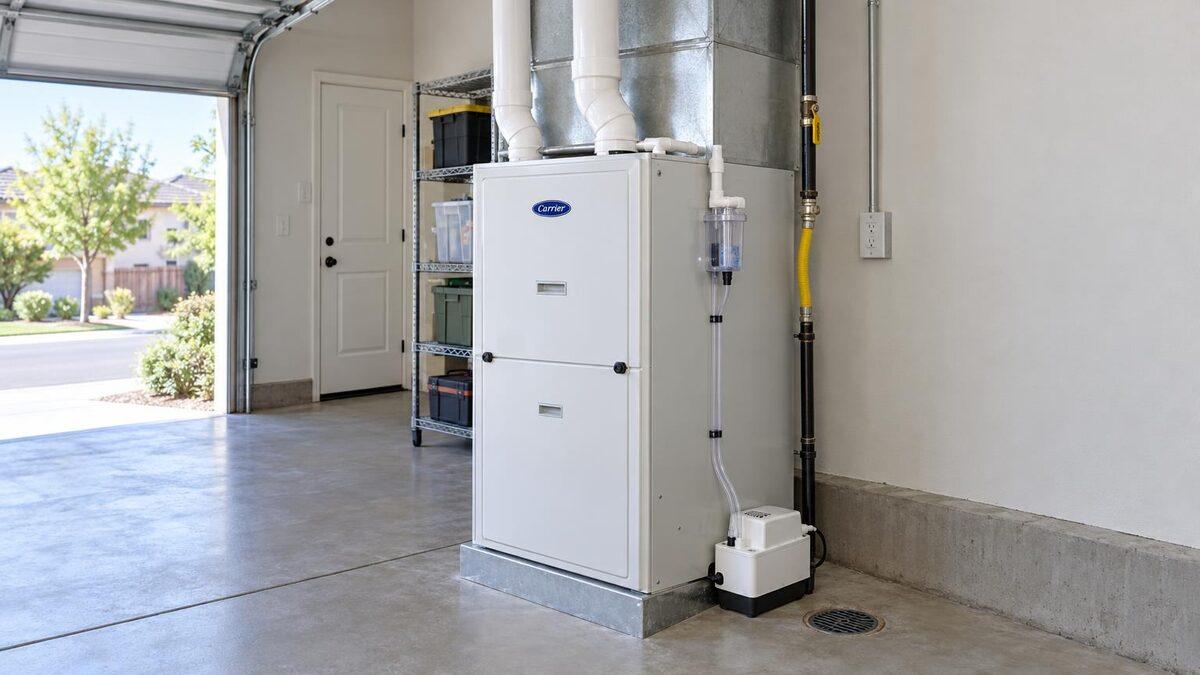
The ENERGY STAR furnace listing sets the efficiency requirements certified furnaces must meet, and the gas furnaces that reach those levels are condensing models. You can usually spot one by its white plastic vent pipes and the small drain tubing on the side of the cabinet.
The water drains through a trap, a looped fitting that holds a little water as a seal, and then through tubing to a floor drain, a standpipe, or a small condensate pump that lifts the water to a drain line. In a cold week of steady heating, that adds up to a steady trickle.
What Clogs the Drain
Three things usually block a high efficiency furnace condensate drain:
- The trap. Sediment and a slimy film build up inside the loop over a season or two until water cannot pass.
- The tubing. A kinked, sagging or disconnected drain tube stops the flow or dumps it in the wrong place.
- The condensate pump. The pump can lose power when its plug is knocked loose, its float can stick, or its outlet tube can clog.
In an attic or closet install, the furnace may also sit over a secondary drain pan with a float switch that cuts power to the system when the pan fills, so a full pan can stop the furnace too. If your furnace sits under a central AC coil, the cooling coil has its own drain as well. That one is busy in summer and mostly idle in winter, so a winter leak usually points to the furnace's own drain.
How a Backup Shuts the Furnace Down
A clogged drain can stop the furnace from running at all, not just make it leak. When water backs up inside the cabinet, a pressure switch that checks the furnace's draft before lighting cannot close, so the control board refuses to start the burners. You see it as a furnace that clicks, runs its small inducer fan, then gives up and flashes an error code.
Here is how it usually looks on a typical first-cold-week call in a Sacramento garage install. The furnace has run fine for years. On the first chilly night it keeps trying to start and quitting. The condensate pump next to it is full and silent, because its plug worked loose from the outlet over the summer. Plugging the pump back in, letting it drain, and flushing the trap gets the furnace running in minutes.
What You Can Check
You can check the easy causes yourself. Start by turning the furnace off at the thermostat and at its service switch.
- Look at the condensate pump. Is it plugged in? Is its reservoir full? Does it run when you lift the float gently? Is its outlet tube clear?
- Follow the drain tubing. It should run downhill to the drain or pump, with no kinks, sags or loose ends.
- Flush the trap. Your furnace manual shows how. Many traps can be removed or opened, flushed with warm water, and reinstalled. Make sure the trap is refilled with water before you restart the furnace, because the trap only seals when it holds water.
- Restart and watch. Turn the power and thermostat back on and see whether the furnace lights and stays on.
Our position: flush the trap once a year, ideally during the fall tune-up, so the slime never builds up enough to cause a cold-morning shutdown.
When It Is Not the Drain
If the drain is clear and the furnace still will not start, or the leak continues, the cause is something else, such as a failed pressure switch, an inducer motor problem, or a crack in the drain fitting inside the cabinet. Those need a technician to test.
When to Call PULSE HVAC
Call us when the furnace still shuts down after you have checked the pump and flushed the trap, when water keeps appearing around the cabinet, or when the error code keeps coming back. A tune-up includes cleaning the trap and testing the pump, which prevents most of these calls.
Call PULSE HVAC at (916) 850-2221 or book a repair online.
Sources
Need HVAC help in Sacramento?
Same-day service · Free estimates · Licensed & insured