
Reviewed by Paul R., CEO & Installer
Most Sacramento homes do not need an AC unit cover for winter. The outdoor condenser is built to sit in the rain year-round, and a valley winter of rain, fog and the odd frosty morning is well within what it was designed for. A full wrap does more harm than good. The one cover worth owning is a breathable top-only cover for a unit that sits under a tree.
It is worth getting right because this is the equipment that does a lot of your home's heavy lifting. ENERGY STAR notes that as much as half of the energy used in a home goes to heating and cooling, and a condenser that spends the winter rusting or full of leaves starts the next summer behind.
Why a Full Cover Does More Harm Than Good
A full plastic or vinyl wrap traps moisture instead of keeping it out. Rain and fog still get in at the bottom, and condensation forms on the inside of the cover on cold nights. With no airflow, that moisture sits against the coil fins, the cabinet and the electrical connections for weeks.
The result shows up in spring: surface rust on the cabinet, corrosion starting on the coil, and a damp, dark, sheltered box that mice and rats love. Rodents nest inside covered units and chew wire insulation. We would rather find leaves in a unit than a nest.
Heavy snow is the reason covers exist in colder parts of the country. Sacramento does not get it. That is the main reason we tell most homeowners here to skip the full cover entirely.
When a Top-Only Cover Makes Sense
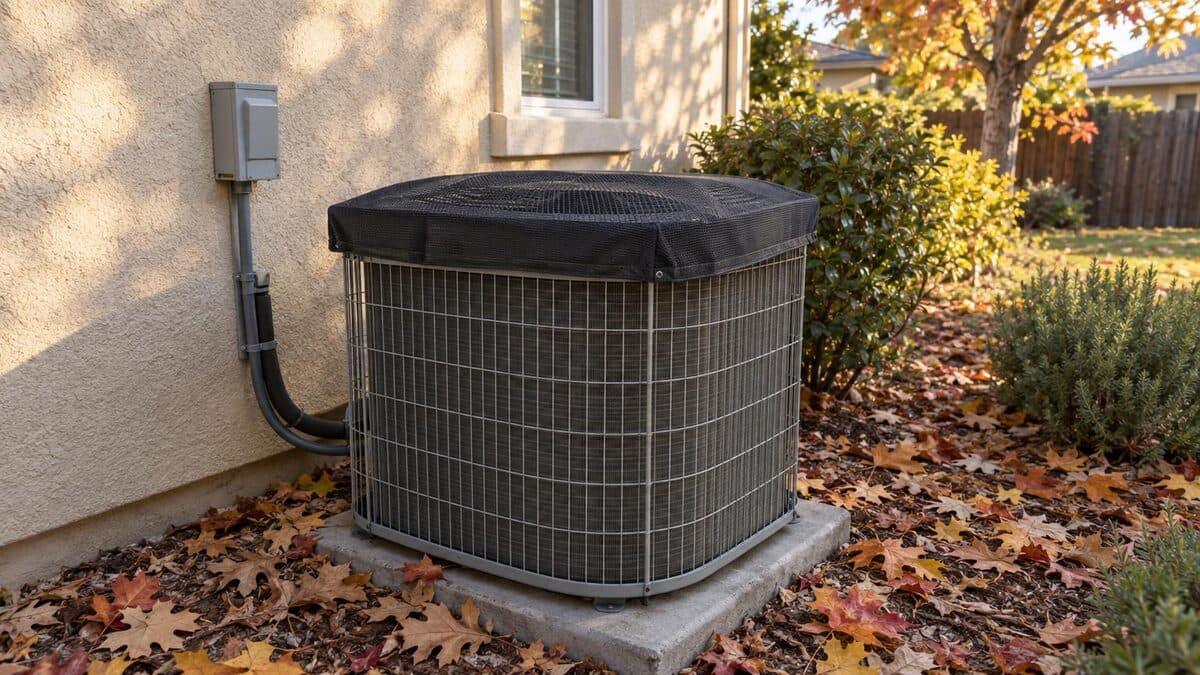
A top-only cover makes sense when the unit sits under trees that drop leaves, needles or seed pods. In older Carmichael neighborhoods with big oaks and sycamores, condensers fill with leaves every fall. They fall through the fan grille, collect on the floor of the cabinet, hold water against the base and mat against the inside of the coil.
A good top cover is a breathable mesh or a solid panel that sits on the fan grille and does not hang down the sides. It keeps debris out of the top while rain and air still move through the coil on all four sides. Avoid anything that ties tight around the bottom.
Timing matters. Warm spells in October and even November are common here, and a thermostat set to auto can call for cooling on an 80°F afternoon. An AC running with its fan grille covered is starved for airflow. Put the cover on after the last warm stretch, or set the thermostat to heat only while it is on, and take it off before the AC runs again in spring.
If you do not have trees overhead, skip it. Rain on an open condenser is normal.
Never Cover a Heat Pump
A heat pump must not be covered in winter, because it is your heating system and it runs all season. It pulls heat from outdoor air through the same outdoor coil, so it needs open airflow on every side and room above for the fan to discharge.
Covering a heat pump blocks that airflow and interferes with its defrost cycle. It also makes the system lean harder on its backup heat. Many homeowners are not sure which they have. If your outdoor unit runs on cold mornings, it is a heat pump, even when the house also has a gas furnace as backup (a dual-fuel system). Leave it uncovered. If you are not sure, check the model label or ask us before covering anything.
What to Do Instead of a Cover
Keeping the area around the unit clear does more than any cover. Before the rainy season:
- Rake leaves and pull weeds from around the base, and keep a couple of feet of open space on every side.
- Trim back shrubs, vines and ornamental grasses that have grown toward the cabinet over the summer.
- Do not stack firewood, bikes, patio cushions or pool equipment against the unit for winter storage.
- Leave rinsing the coil, the inside of the cabinet, the fan and the electrical compartment to a technician.
A clean coil matters for next summer's bills. Central air conditioners carry efficiency ratings under the U.S. Department of Energy standards, and those ratings assume air moving freely through a clean coil. Packed leaves and matted fins take that away.
A Typical Fall Leaf Problem
Here is how it usually looks: a 1960s ranch house with a 2014 condenser tucked beside a side fence under a neighbor's sycamore. Nobody has looked inside the top grille since it went in. By the first warm week of the next summer, several inches of packed leaves sit on the cabinet floor and the lower rows of the coil are matted over. A cleaning clears it, and a top-only cover each fall keeps it from coming back.
When to Call PULSE HVAC
Call us if your outdoor unit is already packed with leaves inside the cabinet, if you see rust, chewed wires or a nest, or if you are not sure whether your system is a heat pump or a straight AC. A fall check is also a good time to have the coil cleaned and the unit looked over before the rainy season.
PULSE HVAC services outdoor AC and heat pump units across the Sacramento area. Call (916) 850-2221 or book online to schedule a visit.
Sources
Need HVAC help in Sacramento?
Same-day service · Free estimates · Licensed & insured