
Reviewed by Paul R., CEO & Installer
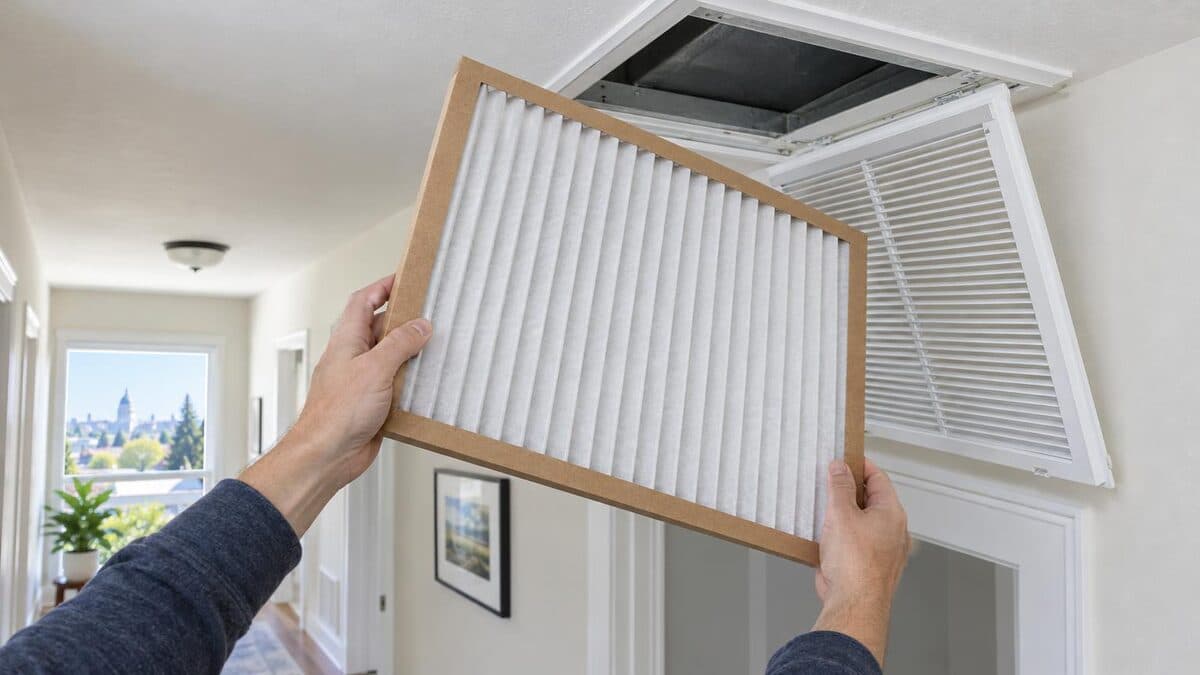
The quickest way to find your furnace filter size is to pull out the filter you have now and read the edge of the cardboard frame. It will say something like 16x25x1: width, height and thickness in inches. Write that down or take a photo, and you have the size for every filter after it. If the label is gone or there is no filter in there at all, you can measure the opening in about two minutes.
Getting it right matters because the filter only works when it fits. ENERGY STAR recommends checking your filter every month during heavy use and changing it at least every three months, which means you will buy this size four or more times a year. A filter that is too small lets dusty air slip around the edges and straight into the blower and coil.
Where to Find the Filter in the First Place
The filter is either behind a return grille in the living space or in a slot at the furnace itself. Find it before you shop.
In a lot of Sacramento-area tract homes, the furnace sits in the attic or garage and the filter lives behind a large grille in a hallway ceiling or wall. That grille is the return: the big opening where the system pulls air back in. It usually has two thumb latches or a pair of screws. Swing it open and the filter sits right behind it.
If your furnace is in a closet or the garage and the return grille has no filter behind it, look at the furnace cabinet. There is often a slot on the side of the return duct just before it enters the furnace, with a thin cover you slide or lift off. Some systems have a deeper filter cabinet bolted between the duct and the furnace.
Some homes have two or more returns, each with its own filter. Check every large grille in the house. Missing one of them is one of the most common things we see on a filter visit.
Nominal Size vs. Actual Size
The size printed in big type on a filter is the nominal size, a rounded label, and the filter itself is a bit smaller. A 16x25x1 filter usually measures about 15.5 by 24.5 inches and a little under an inch thick. The difference is deliberate, so the filter slides into the slot without binding.
That is why measuring the old filter with a tape and buying "15.5x24.5" sends people hunting through store aisles for a size that does not exist on the shelf. Shop by the nominal size. Many frames print the actual dimensions in smaller type as well, which is handy for checking.
Thickness matters as much as width and height. A 1-inch slot takes a 1-inch filter. A 4- or 5-inch media cabinet takes a 4- or 5-inch filter. Do not force a thick filter into a thin slot or leave a gap with a thin filter in a deep cabinet.
How to Measure When the Label Is Gone
When there is no readable label, measure the opening, not the old filter. Old filters get bent and crushed, and the opening is what the new one has to fit.
- Measure the width and height of the filter slot or the frame the filter sits in behind the grille.
- Measure the depth of the slot or cabinet front to back.
- Match those measurements to the nearest standard size on the shelf, which is usually the next whole inch up. An opening of 15 5/8 by 24 5/8 inches by 7/8 inch deep is a 16x25x1.
- Write the size on the furnace cabinet or the inside of the grille with a marker, so the next person does not have to repeat this.
Searching by furnace model number works only for a filter slot at the furnace. The installation manual lists the size for that model. A filter behind a hallway grille is sized to the grille, which has nothing to do with the furnace model, so measure it instead.
Which Way the Arrow Points
The arrow on the filter frame points the direction air flows, toward the furnace and away from the room. Behind a ceiling grille the arrow points up into the duct. In a slot at the furnace, it points toward the blower cabinet.
A filter put in backward still catches dust, but the pleats and backing are built to load from one side. If yours is in backward, turn it around now.
Upgrade the Filter Rating, Not the Size
Keep the same size and change only the filter's rating if you want better filtration. Size is set by the opening. Rating is a separate choice.
The EPA explains MERV ratings, the scale that tells you how fine a filter captures particles. Higher ratings catch more but also resist airflow more, especially in a thin 1-inch filter. Our take for most Sacramento homes: a pleated 1-inch filter in the MERV 8 range, changed on time, beats a high-rated one left in for six months. If you want serious filtration, the better route is a 4-inch media cabinet, which gives the system far more filter area for the same airflow.
A Typical First-Cold-Morning Filter Problem
Here is how it usually looks: a 1990s Roseville two-story, a new owner turning on the heat in mid-October and wondering when the filter was last changed. The hallway ceiling return holds a 20x25x1 filter that the label says went in last spring. Upstairs, a second return the owner never noticed has a filter that has been there longer than they have owned the house. Both get replaced, and both sizes get written on the grilles so the next change takes five minutes.
When to Call PULSE HVAC
Call us if you cannot find the filter at all, if the filter slot has no cover and gaps around it, or if you want a 4-inch media cabinet added for better filtration. We can also check whether your returns are sized well for your system, which affects which filters it can handle.
PULSE HVAC services furnaces, heat pumps and air filtration across the Sacramento area. Call (916) 850-2221 or book online to schedule a visit.
Sources
Need HVAC help in Sacramento?
Same-day service · Free estimates · Licensed & insured