
Reviewed by Paul R., CEO & Installer
When your return air vent is whistling, air is being forced through an opening that is too small for it. Most of the time, that opening is a gap around the filter or a filter so loaded with dust that air rushes around its edges instead of through it. The rest of the time it is the grille itself, or a return that was never big enough for the blower behind it. Start with the filter, because it is free to check and fixes most of them.
The filter is the part most homes neglect. ENERGY STAR recommends checking it every month during heavy use and changing it at least every three months. A return that started whistling a few weeks ago and gets louder each day is almost always telling you the filter is due.
Why a Return Vent Whistles
A whistle is the sound of fast air through a narrow slot. Your system's blower pulls a fixed amount of air through the return. If the easy path through the filter gets harder, the air finds the next easiest one: the thin gap between the filter frame and the grille, a bent louver, or an unsealed seam in the return box.
Air squeezing through a quarter-inch gap moves fast, and fast air through a thin slot whistles. It is the same physics as blowing across a bottle.
A roar or loud rush is a little different. That is the sound of a lot of air moving through the whole grille at once. It points to a return that is too small for the system, a grille with a restrictive face, or a blower set to a high speed.
Check the Filter First
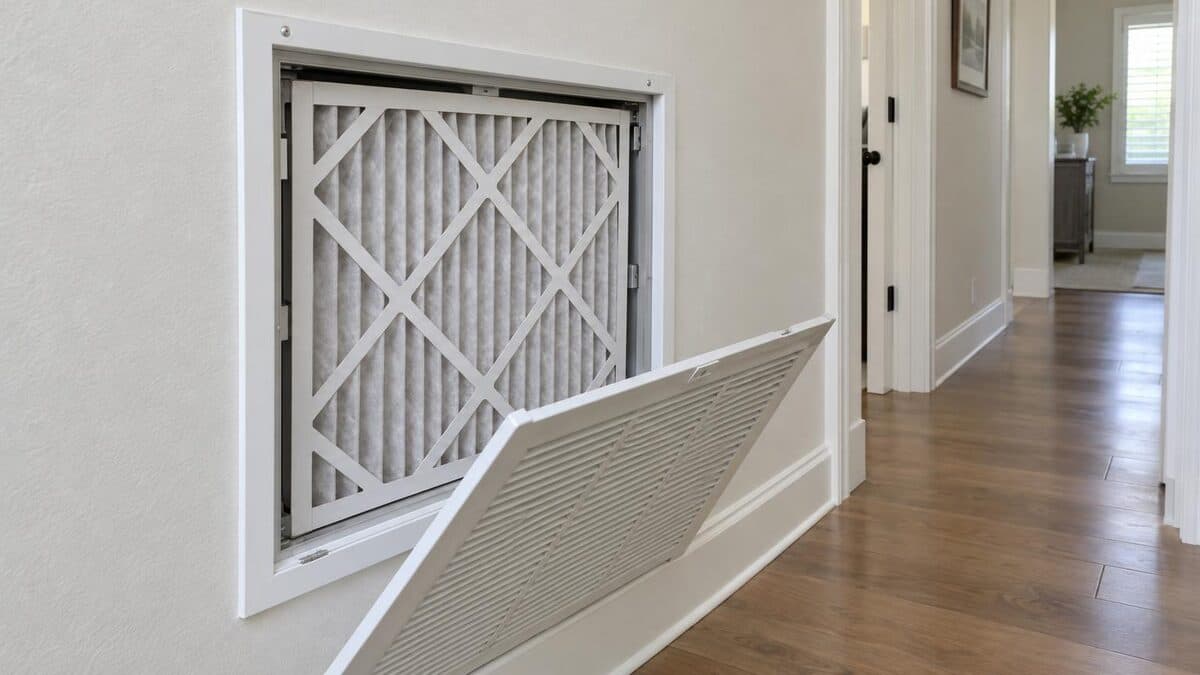
Most whistling returns go quiet with a clean filter that fits. Open the grille, pull the filter and look at three things.
Is it dirty? If the face is gray and matted, replace it and listen. A whistle that fades with a fresh filter and comes back a month later is just a filter schedule problem.
Is it the right size? A filter that is a size too small leaves a gap along one edge, and that gap whistles every time the blower runs. Read the nominal size printed on the frame and match it to the opening. Our post on finding your furnace filter size walks through measuring when the label is gone.
Is it seated flat? A filter pushed in crooked, bowed in the middle or caught on the grille latch leaves a gap even when the size is right. It should sit flat against its frame on all four sides with the airflow arrow pointing into the duct.
Filter choice matters too. The EPA explains that higher MERV ratings capture finer particles, and in a thin 1-inch filter that usually means more resistance to airflow. A high-rated 1-inch filter in a return that is already on the small side is a common recipe for a whistle. If yours started after an upgrade, try a mid-range pleated filter and compare.
Then Look at the Grille
If a clean, correctly seated filter still whistles, the grille is the next suspect.
- Bent louvers or fins. A grille that has been bumped by a vacuum or a moving box often has a few fins pinched together. Straighten them gently by hand.
- Loose face or frame. A hinged filter grille that does not close tight can rattle or whistle at the latch side. Check that both latches catch.
- Gaps behind the frame. If the grille is not flush to the wall or ceiling, air can be pulled through the gap between the frame and the drywall instead of the filter. A technician can seal that edge.
- Restrictive face style. Some decorative and stamped-face grilles have much less open area than a standard louvered one. Swapping to a grille with more open area is an inexpensive change.
When the Return Is Simply Too Small
A return that stays loud with a clean filter and a good grille is usually undersized for the blower. That is common in tract homes from every decade around Sacramento: one central return in the hallway, sized for the original equipment, now feeding a replacement system with a stronger blower.
Our position: if the return roars with a clean filter, do not keep buying thinner, cheaper filters to quiet it. That trades noise for dirtier coils. The real fixes are a larger return grille and duct, a second return in a far bedroom wing, or a blower speed adjustment where the equipment allows it. A technician can measure the pressure across the return and tell you which one fits.
A Typical Hallway Return
Here is how it usually looks: a 1980s Citrus Heights single-story with one hallway return and a newer system installed a few years ago. The owner switched to a high-rated 1-inch filter for allergy season, and within a week the hallway started whistling. The filter is a half-inch short on one side, and the high rating makes air pile up against it. A correctly sized mid-range filter quiets it. If the rush is still loud after that, the return gets measured.
When to Call PULSE HVAC
Call us if the return still whistles or roars with a clean, correctly seated filter, if you can feel air pulling in around the edge of the grille, or if the noise started after new equipment was installed. We will measure the return and tell you whether the fix is a grille, a duct change or a second return.
PULSE HVAC services airflow and return problems across the Sacramento area. Call (916) 850-2221 or book online to schedule a visit.
Sources
Need HVAC help in Sacramento?
Same-day service · Free estimates · Licensed & insured