
Reviewed by Paul R., CEO & Installer
Before you turn on a gas furnace for the first time this fall, check your carbon monoxide detector placement, age and batteries. You need one in the hallway outside every sleeping area and at least one on every level. That five-minute check matters most right now, because the first heat cycles after a long Sacramento summer are when a cracked part, a blocked flue or a disconnected vent pipe first shows up.
Carbon monoxide is colorless and odorless, so your senses will not warn you. The EPA puts typical levels in homes without gas stoves at 0.5 to 5 parts per million, and levels near properly adjusted gas stoves at 5 to 15 ppm. A home CO alarm is not built to measure those everyday levels. Its job is to sound when carbon monoxide builds to a dangerous concentration, which is exactly what a failing furnace or blocked flue can cause.
Are Carbon Monoxide Detectors Required in California?
Yes. California law requires carbon monoxide alarms in homes that have a fuel-burning appliance such as a gas furnace or water heater, a fireplace, or an attached garage. That covers most homes in the Sacramento area, including all-electric homes with an attached garage.
The alarms you install must be approved for use in California. Check the package listing before you buy, especially for an inexpensive unit ordered online.
Where Carbon Monoxide Detectors Should Go
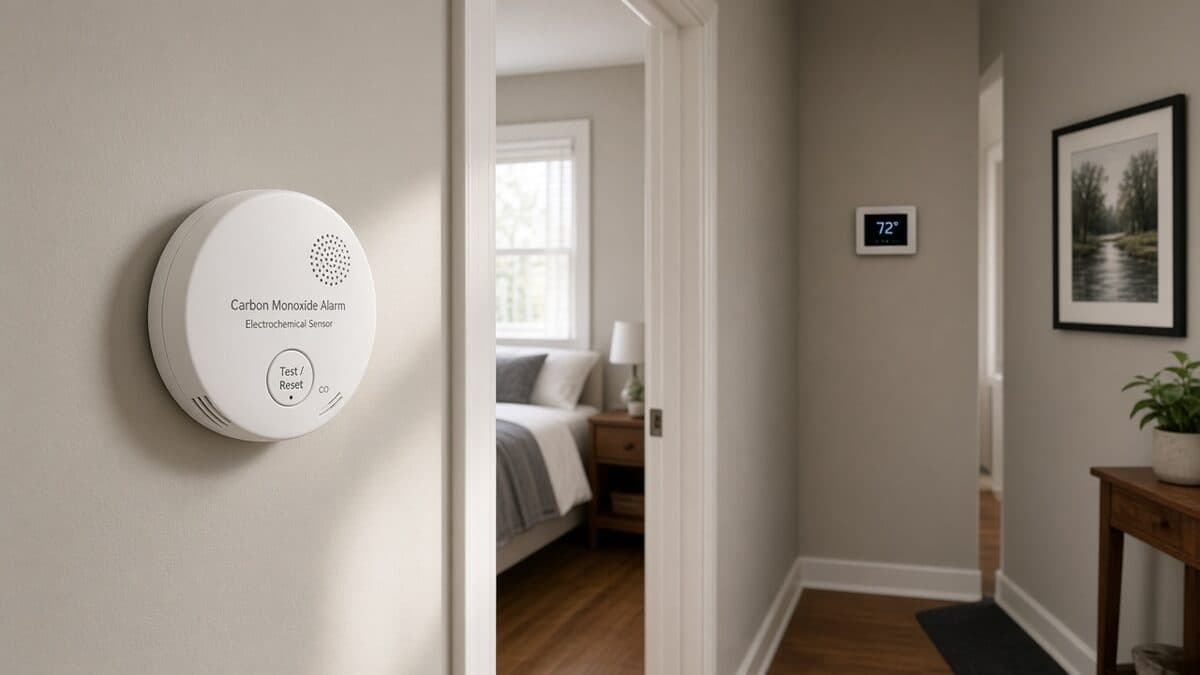
Place one in the hallway outside each sleeping area and at least one on every level of the house. Bedrooms come first because carbon monoxide is most dangerous when people are asleep and cannot notice early symptoms like headache or dizziness.
A few placement mistakes come up again and again:
- In the garage. Car exhaust on a cold morning sets off nuisance alarms, and the alarm is not protecting the people inside.
- Right next to the furnace or water heater. A brief puff at startup can trigger a false alarm. Follow the manual's minimum distance from fuel-burning appliances.
- In the kitchen or a bathroom. Cooking fumes and humidity shorten sensor life and cause false alarms.
- Behind furniture or curtains. The sensor needs open air around it.
- Only one alarm for a two-story house. A single unit downstairs can miss what is happening near the bedrooms upstairs.
Plug-in, battery and hardwired units all work. A combination smoke and CO alarm counts as long as it is listed for both. Our position: if your home has hardwired smoke alarms, replace them with hardwired combination units when they come due. You get both alarms on every level without adding more devices to keep track of.
Why Your Carbon Monoxide Detector Is Chirping
A single chirp every minute or so usually means a low battery or an alarm that has reached the end of its life. The exact pattern differs by brand. Check the label on the back of the unit or the manual. Many brands use a different chirp pattern for end of life than for a low battery.
A chirp is not the same as an alarm. The alarm is a loud, repeating pattern that keeps going. That means the unit is detecting carbon monoxide, and you need to get outside.
How Often to Replace a Carbon Monoxide Detector
Most carbon monoxide alarms are designed to last roughly five to ten years. Many have the replacement date printed on the back. Replace a unit when it reaches that date, when it gives an end-of-life signal, or when it fails its test button check.
The fall check takes a few minutes:
- Press and hold the test button on every alarm until it sounds.
- Replace batteries in battery-only units, and the backup battery in plug-in and hardwired units.
- Read the date on the back of each unit and replace any that are past it.
- Write the install date on any new unit with a marker.
A typical pattern in older Sacramento homes, especially 1970s ranch houses in places like Citrus Heights: one plug-in CO alarm in the living room, put there years ago, now past its date and unplugged because it got in the way of a lamp. Nothing outside the bedrooms. The furnace in the hall closet is about to start running every morning for five months. Two or three new alarms placed correctly cost far less than the risk they cover.
What to Do If Your Carbon Monoxide Detector Goes Off
Get everyone, including pets, out to fresh air right away. Then call 911 or the fire department from outside. Do not stay inside with the windows open, and do not go back in until responders say it is safe.
Before you run the furnace, water heater or any gas appliance again, have it inspected. An alarm on the first cold morning of the season is exactly the case where a cracked heat exchanger, a blocked flue or a vent pipe that came loose over the summer needs a technician, not a reset button. The EPA's indoor air quality resources cover carbon monoxide alongside other indoor pollutants if you want more background.
When to Call PULSE HVAC
Call us if a carbon monoxide alarm has gone off and responders have cleared the house, if an alarm keeps going off near the furnace or water heater, or if you want the furnace checked before the first cold snap. A fall furnace inspection includes checking the venting, the burners and the heat exchanger, which are where carbon monoxide problems start.
PULSE HVAC serves homeowners across the Sacramento area. Call (916) 850-2221 or book online to schedule a furnace safety check.
Sources
Need HVAC help in Sacramento?
Same-day service · Free estimates · Licensed & insured