Reviewed by Alex J., Lead HVAC Technician, NATE Certified
The best thermostat setting for summer isn't a single magic number — it's a range you dial in based on how you're using the rest of your home. For Sacramento homeowners facing summer temperatures that regularly push past 95°F, getting this combination right can mean real money saved without sweating through the season.
Here's the core strategy: set your thermostat 2–4°F higher than you normally would, run ceiling fans correctly, and you'll feel just as cool — sometimes cooler — while your AC works less. Let's break down exactly how that works.
Why the Standard 78°F Recommendation Actually Works
The U.S. Department of Energy recommends 78°F when you're home during summer. That number catches pushback from people who think it sounds miserable, and in Sacramento's dry, punishing heat, skepticism is fair.
But here's the part most people skip: each degree you raise your setpoint saves roughly 3% on your cooling bill. Push from 74°F to 78°F and you're looking at around 12% in savings — meaningful on a $300 July electric bill in Elk Grove or Rancho Cordova.
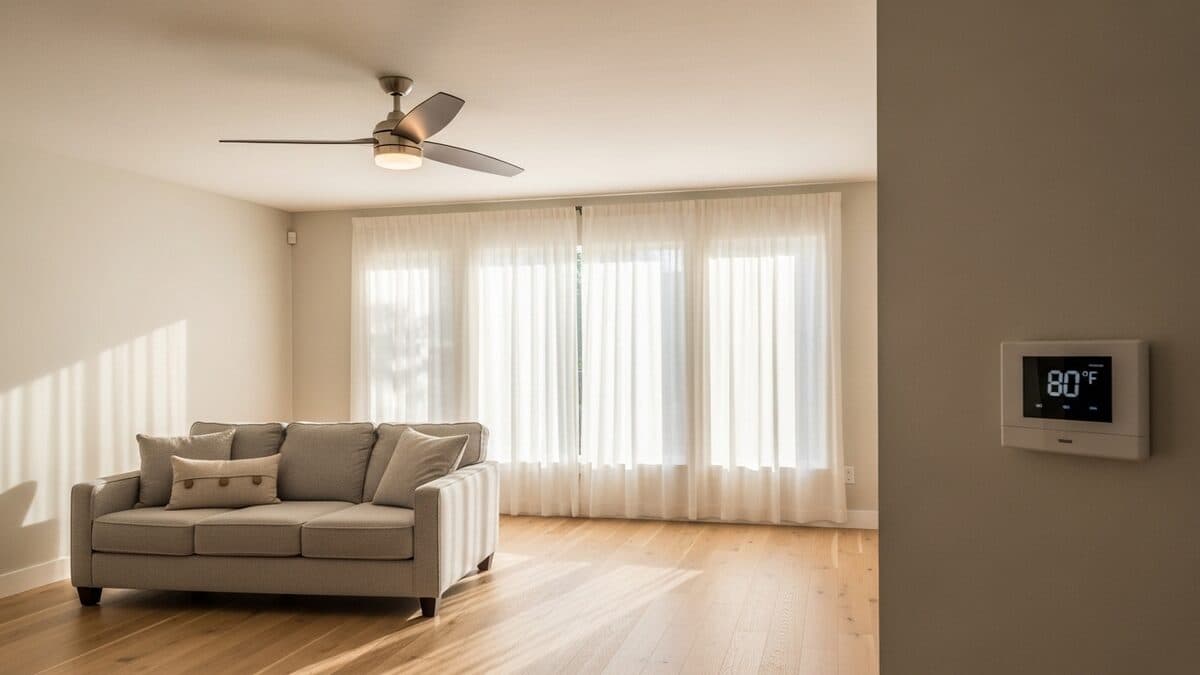
The ceiling fan is what makes 78°F feel livable. Moving air creates a wind-chill effect on skin that makes a room feel 4–6°F cooler than the actual air temperature. So 78°F with a fan running can feel like 73–74°F. That's the entire strategy, and it works.
How to Use Ceiling Fans Correctly With Your AC
Most people run ceiling fans constantly and forget about them. That's not wrong, but it's not optimized either.
Set the fan direction right. In summer, ceiling fan blades should spin counterclockwise (when viewed from below). This pushes air straight down, creating the wind-chill effect on people in the room. Clockwise rotation is for winter — it pulls air up and pushes warm air down from the ceiling.
Turn fans off in empty rooms. Fans cool people, not rooms. If you leave a fan running in an empty bedroom while you're in the kitchen, you're burning electricity for zero comfort benefit. Make it a habit: walk out, fan off.
Pair fan use with a higher setpoint. If you currently keep your thermostat at 74°F, try bumping it to 76–77°F with the ceiling fan running. Give it 30 minutes. Most people in Carmichael, Fair Oaks, and Folsom who try this report the same or better comfort — with their AC running noticeably less.
Getting Your Thermostat Settings Dialed In
Running ceiling fans without adjusting your thermostat settings is like buying better tires without inflating them. The combination is what delivers results.
Use a programmable or smart schedule. The best thermostat for home cooling in Sacramento is one that lets you schedule setpoints around your actual life. Set 80–82°F while you're at work (with the AC still running to avoid humidity buildup), then drop to 78°F about 30 minutes before you arrive home. Your house will be comfortable when you walk in, and you haven't been paying to cool an empty house all afternoon.
Use geofencing if your thermostat supports it. Smart thermostats with geofencing detect when your phone leaves the area and automatically shift to an energy-saving setpoint — then cool the house as you head back. For homeowners in Roseville or Citrus Heights with long commutes, this feature alone can cut cooling costs meaningfully.
Don't set it and forget it. How thermostats control temperature is straightforward — they trigger your AC to run when the indoor temp rises above the setpoint. But a setpoint that makes sense on a 92°F day may be too conservative on a 105°F day. Check your settings when heat waves hit and adjust accordingly.
When Your Thermostat Is the Problem
Sometimes the issue isn't your settings — it's the hardware. If your thermostat is more than 10–15 years old, it may be reading temperatures inaccurately, losing programmed settings, or causing your system to short-cycle (turn on and off too frequently). Any of those problems will cost you more in wasted energy than a replacement would.
Basic programmable thermostats run $20–$80 for the unit. Smart thermostats range from $150–$300. Add $75–$150 for professional installation in the Sacramento area. Most homeowners recover that cost within one to two cooling seasons — and that's before you factor in pairing it with ceiling fans and raising your setpoint.
If you're wondering about the cost to replace a thermostat in your house, the honest answer is that it's one of the better-returning HVAC investments you can make during summer.
When to Call PULSE HVAC
A ceiling fan and thermostat adjustment will carry you far, but there are situations where you need a professional.
Call us if:
- Your thermostat display is blank or unresponsive after checking the breaker and replacing batteries
- Your AC is short-cycling — running for only a few minutes before shutting off, then restarting
- Your home can't reach the setpoint even when the system runs continuously during peak heat
- You want a smart thermostat installed correctly, with proper wiring checks and calibration
- Your energy bills have spiked without any change in your usage habits
These symptoms often point to something beyond a settings fix — refrigerant issues, failing capacitors, duct leaks, or a thermostat that needs replacement. Catching them early in the season is far better than diagnosing them during a peak heat-wave emergency.
PULSE HVAC serves Sacramento, Carmichael, Roseville, Citrus Heights, Folsom, Elk Grove, Rancho Cordova, and Fair Oaks. Our technicians know the specific demands this valley heat puts on residential systems, and we're not going to sell you equipment you don't need.
Start With the Simple Stuff
Before you call anyone, try this today: switch your ceiling fans to counterclockwise, raise your thermostat setpoint by 2°F, and turn fans off in rooms you're not using. That's a free adjustment that can reduce your cooling costs by 6% or more — no parts, no service call.
If you want to go further — a smart thermostat, a system checkup, or just a straight answer about why your AC is struggling — PULSE HVAC is ready. Call (916) 850-2221 or book an appointment online at /book. We'll make sure your setup is actually working for you this summer.
Sources
Need HVAC help in Sacramento?
Same-day service · Free estimates · Licensed & insured