
Reviewed by Alex J., Lead HVAC Technician, NATE Certified
Closing unused bedrooms while the AC runs is usually a bad idea in a typical Sacramento-area house. Most homes here still use a central hallway return, so the question of whether to close bedroom doors while the AC is running is really a return-path question, not a “keep the spare room from wasting cold air” question. Shut the doors and supply air has nowhere to complete the circuit. Pressure builds, the blower moves less air through the filter, and the rooms you actually occupy hold onto more dust.
ENERGY STAR reports that 20 to 30 percent of the air moving through a duct system is lost to leaks. That loss already exists in a lot of 1970s tract houses around Sacramento. Closing interior doors stacks a second problem on top of the first: the remaining air cannot get back to the return, so filtration and even cooling both drop.
Why a shut bedroom door wrecks return-path airflow
A hallway return needs air from every room that has a supply register. Close the door and the supply still dumps into that bedroom. The room goes positive. The hallway and living area go negative. The blower works against higher static pressure and simply moves less air. That is the same imbalance you get if you close bedroom doors when heat is on in winter. The season changes. The physics do not.
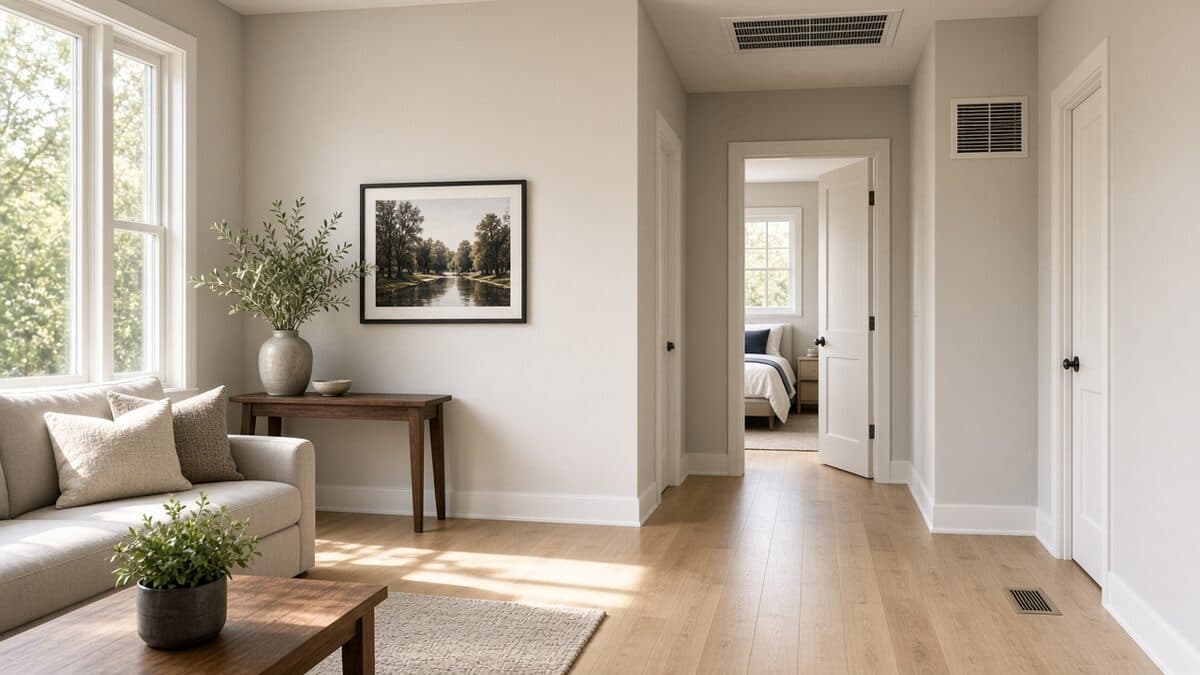
Leave doors cracked unless a bedroom has its own return. A two-inch gap under the slab, or a transfer grille, is enough for the circuit to close. Fully shut doors do not “save” cooling. Unused rooms still leak around the door, and the occupied space does not get more filtered air.
Last August we opened a 2009 split in a 1970s ranch off Fair Oaks Boulevard. The filter was gray cardboard from the previous owner. Two spare bedrooms had been shut all summer “to keep the living room colder.” Supply was roaring at the registers. Return velocity at the grille was weak. After we left those doors on a two-inch crack, the same filter loaded slower and the hallway stopped feeling like a wind tunnel.
Does closing unused bedroom doors keep smoke and dust out?
Not reliably. Closed doors do not seal a room from the rest of the house. They often reduce whole-house airflow through the filter, so particles stay in the occupied rooms longer. EPA indoor air quality guidance is built around moving indoor air through filtration and ventilation, not trapping it behind a door slab. Filtration works when air can complete the circuit back to the return.
Wildfire smoke and valley dust still migrate under the door, through the latch, and through the ducts. If you want cleaner air in the rooms you use, keep the path to the return open so the filter actually sees that air.
Should you close your bedroom door at night in summer
Only if each occupied room still has a clear path to a return. Closing bedroom doors at night is common, and closing bedroom doors at night during a 100-degree streak feels like common sense. It can starve the return and make hallways cooler while bedrooms get stuffy. A two-inch gap or a transfer grille is a better night setup than a fully shut door.
If you close the bedroom door when sleeping because of noise or privacy, crack it or add a jumper duct. Interior doors at night in summer are fine only when return air is not blocked. The Delta breeze can drop outdoor temperatures after midnight, but your blower still needs a path while it runs through SMUD’s late-afternoon peak.
Is it better for AC if unused rooms stay closed
Not for typical ducted systems. Closing unused rooms does not save cooling; it imbalances supply and return. The blower works against higher pressure, rooms with open doors can feel drafty, and unused rooms still leak air around the door slab. Extra supply can dump into the living area for a short time. Without a path back, pressure rises, airflow drops, and the occupied space does not actually get more filtered, even cooling.
Skip the habit of shutting every spare room “to help the AC.” Keep a return path open. If a bedroom has its own return grille, that door can close. If it does not, leave it cracked.
When to Call PULSE HVAC
Call when closed doors are the only way you can get a bedroom private and the rest of the house still feels uneven, noisy at the registers, or dusty even after a filter change. That is a return-path and static-pressure problem, not a thermostat problem. PULSE HVAC can check whether a transfer grille, undercut, or jumper is the right fix for your layout in Sacramento or Folsom.
Book online at /book or call (916) 850-2221. We will look at how your doors, returns, and filter actually work together before we sell you a new habit.
Sources
Need HVAC help in Sacramento?
Same-day service · Free estimates · Licensed & insured