
Reviewed by Paul R., CEO & Installer
A duct leakage test tells you, in one number, how much of your heating and cooling air escapes before it reaches a room. A technician seals off the registers, pressurizes the ducts with a calibrated fan, and measures how much air the fan has to push to hold that pressure. ENERGY STAR estimates that in a typical house, 20 to 30 percent of the air moving through the duct system is lost to leaks, holes and poorly connected ducts. The test shows where your house falls.
In the Sacramento area that matters more than in most places, because most of our ducts run through attics that bake in summer and chill on winter nights. Air that leaks there is gone.
What Is a Duct Leakage Test?
A duct leakage test is a pressure test of your duct system, much like checking a tire for a slow leak. It answers a simple question: with every intended opening closed, how much air still gets out?
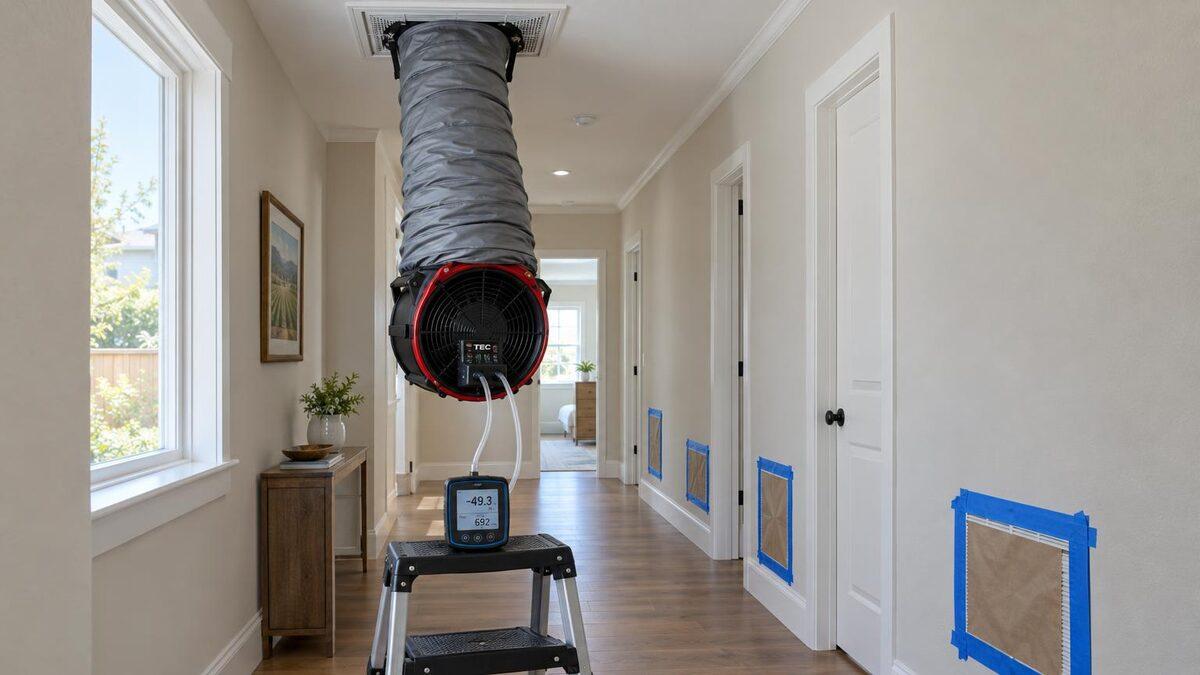
The equipment is a calibrated fan, often called by the brand name Duct Blaster, and a digital pressure gauge. The fan connects to the system at the return grille or the air handler. Every other supply and return register gets covered with tape or paper, so the only way air can leave is through leaks.
How the Test Works, Step by Step
The test works by holding the ducts at a fixed pressure and measuring the airflow needed to keep them there. Here is how it usually goes in a single-story ranch with one system:
- The technician turns the system off at the thermostat and pulls the filter.
- Every supply and return register gets taped over.
- The test fan attaches to the return grille or the air handler, with a hose from the gauge into a supply duct.
- The fan raises the duct pressure to 25 pascals, about one tenth of an inch of water column. That is a typical pressure inside residential ducts while the system runs.
- The gauge reads how much air the fan pushes to hold that pressure. That airflow, in cubic feet per minute, is the leakage, written as CFM25.
The whole visit usually takes an hour or two. Taping the registers takes most of it. The measurement itself takes minutes.
There are two versions. A total leakage test measures every leak, including ones that dump air into the house, where it still does some good. A leakage-to-outside test adds a blower door in an exterior doorway and brings the house to the same pressure as the ducts, so only leaks to the attic, crawlspace or outdoors register. That version takes longer and tells you more about your bill.
When California Requires a Duct Leakage Test
Title 24, California's Building Energy Efficiency Standards, ties duct testing to permitted HVAC work. The usual triggers in an existing home are replacing the central furnace, air conditioner or heat pump, and adding or replacing ductwork. A HERS rater, an independent third party, verifies the result before the permit closes.
The permit for your project spells out whether the test applies and what target the ducts must meet. If a contractor quotes a system replacement with no permit and no test, ask why. Skipping the permit leaves you without a verified number, and leaky ducts stay leaky under a brand-new unit.
How to Read Your Duct Leakage Test Report
A CFM25 figure means little until you compare it to your system's airflow. A 2-ton system moves far less air than a 5-ton system, so the same leakage is a much bigger share of the smaller one. Most reports and the energy code express the result as a percentage of the system's airflow for exactly that reason.
Here is the math on a 3-ton system. Installers commonly figure about 400 cubic feet per minute of airflow per ton, so that system moves roughly 1,200 CFM. A reading of 300 CFM25 is 25 percent of the airflow, right in the range ENERGY STAR calls typical, and plenty of room to improve. A reading of 60 CFM25 is 5 percent, which means the ducts are tight and your money belongs elsewhere. On a permitted job, the HERS rater compares your percentage to the code target for that type of project and passes or fails it. Ask the rater or your contractor for that target before the test, so you know the number you are aiming for.
Then look at where the leaks are, because the location decides the fix. A typical result on a 1970s tract house around Sacramento looks like this: the air handler sits in a hall closet or the garage, the platform under it was never sealed, the original flex duct in the attic has a few runs pulled loose at the boots, and one branch is crushed flat where someone walked across it. Each of those is a different repair. A few bad joints at the air handler are a quick mastic job. A whole attic of tired flex duct is a replacement conversation.
Our position is simple: test before you pay for sealing, and test again after. A before-and-after number is the only proof that the sealing worked. A contractor who seals without testing is guessing.
What Happens After the Test
The next step depends on the number and the cause. Low leakage means your ducts are not the problem, and your money goes further somewhere else, such as attic insulation or the equipment itself. Moderate leakage at a few accessible joints usually gets hand-sealed with mastic. Widespread leakage across many hidden connections points toward aerosol sealing from the inside or new ductwork, which our duct sealing options guide covers in detail.
Either way, the retest closes the loop. It confirms the work and, on a permitted job, gives the HERS rater the number they need.
When to Call PULSE HVAC
Call us if some rooms never get comfortable, your attic ducts are original to a decades-old house, or you are planning a system replacement and want to know where your ducts stand first. A duct leakage test answers those questions with a number instead of a guess.
PULSE HVAC tests, seals and replaces ductwork across the Sacramento area. Call (916) 850-2221 or book a visit online.
Sources
Need HVAC help in Sacramento?
Same-day service · Free estimates · Licensed & insured