
Reviewed by Paul R., CEO & Installer
Your main duct sealing options are hand sealing with mastic and foil tape, and aerosol sealing that closes leaks from inside the ducts. Hand sealing is the right tool for the joints you can reach: the connections at the air handler, the plenums and the register boots, which is where most leaks start. Aerosol sealing reaches the small leaks you cannot get to. Neither one fixes a duct that is crushed or has come apart, so the right plan starts with a test and a look in the attic.
The payoff can be real. ENERGY STAR estimates that in a typical house, 20 to 30 percent of the air moving through the duct system is lost to leaks, holes and poorly connected ducts. In a Sacramento attic, that is either cooled air escaping into a space that hits well over 100°F in summer, or hot attic air being pulled into your return.
How Leaks Get Measured First
A duct leakage test tells you how much air the system is losing before anyone picks a method. A technician blocks the registers, connects a calibrated fan to the system, pressurizes the ducts and measures how much air escapes. The result is a number you can compare before and after the work.
This is also how California measures it. When ducts are replaced or a system is changed out, the state's building energy efficiency standards often require a leakage test and third-party verification. A good contractor tests whether or not a permit requires it, because sealing without a before-and-after number is guesswork.
The test is followed by an attic inspection. That is where you find the problems sealing cannot fix: a flex duct that slipped off its collar, a run crushed flat by someone walking the attic, or a duct with its outer jacket torn open.
Hand Sealing: Mastic and Foil Tape
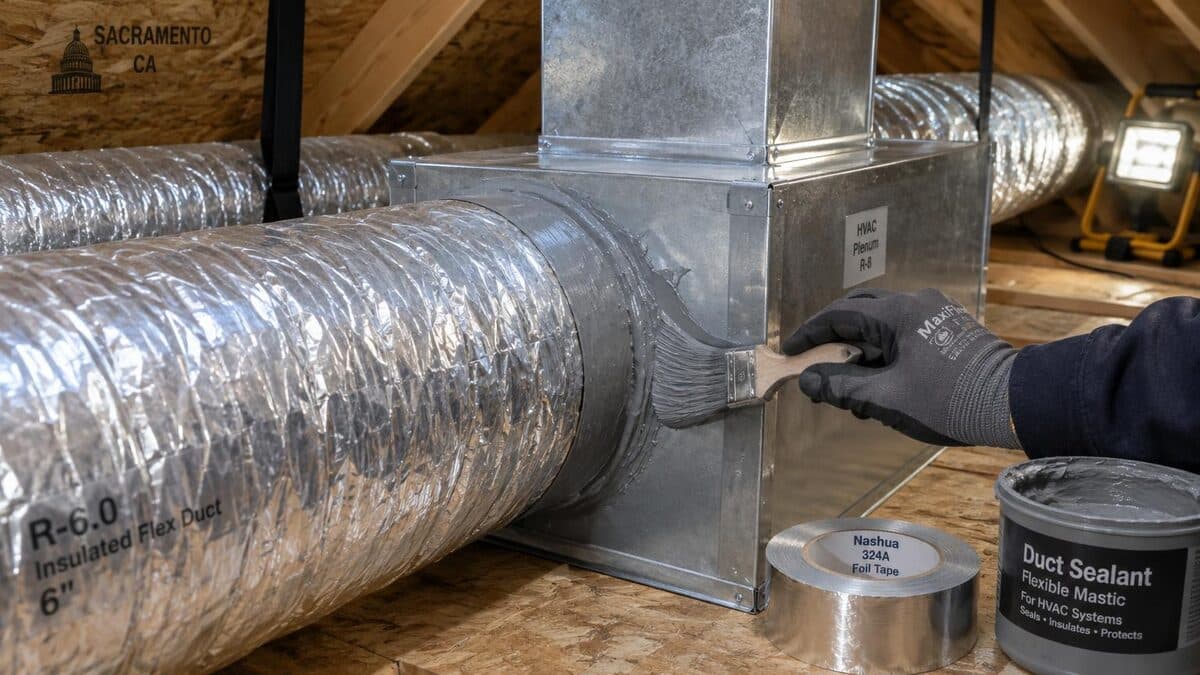
Hand sealing is the backbone of most duct repairs. The technician goes joint by joint and closes each leak directly.
- Mastic is a thick paste brushed over seams and connections. It stays flexible and bonded for years in attic heat. For gaps wider than a pencil line, it goes over a fiberglass mesh tape so it does not sag into the gap.
- Foil tape rated for duct use works on clean, flat sheet metal seams. It is faster than mastic but less forgiving on rough or dusty surfaces.
- Ordinary cloth duct tape is the wrong product. Its adhesive dries out in attic heat, and the seal fails, often within a few seasons.
Hand sealing works best on the high-value joints: the plenum at the air handler, the trunk connections, and the boots where each duct meets a ceiling register. In a lot of homes, those few spots account for much of the leakage.
Its limit is reach. Ducts buried under blown insulation, run between floors in a two-story house or tucked into a tight eave are hard or impossible to seal by hand.
Aerosol Sealing: From the Inside
Aerosol duct sealing closes leaks from inside the system. The registers are blocked, the air handler and coil are protected, and a fine sealing mist is blown into the pressurized ducts. As air escapes through each gap, the particles collect at its edges and build up until the gap closes.
Its strengths are reach and measurement. It seals small leaks anywhere in the system, including runs nobody can crawl to, and the equipment logs leakage before, during and after, so you get a report showing the improvement.
Its limits are the size of the gap and the condition of the duct. It is designed for small leaks, not a duct that has separated from its fitting or a hole you could put a hand through. Those still need hands-on repair first.
How to Choose Between Them
Our position: start with the test and the attic inspection, fix the disconnected and crushed sections by hand, and seal the major joints with mastic. Then retest. If leakage is still high and the remaining leaks are in places nobody can reach, aerosol sealing is the right next step.
Many homes end up with both. Hand sealing handles the big, accessible leaks that aerosol sealing cannot close, and aerosol sealing handles the scattered small leaks that hand sealing cannot reach.
A typical version of this in Citrus Heights: a 1970s ranch with original sheet metal trunks and flex duct added during an AC replacement years later. The leakage test comes back high. In the attic, two boots have pulled away from the ceiling drywall and one flex run has slipped off its collar. Reattaching those and sealing the plenum with mastic takes care of the biggest losses, and the retest shows whether the remaining small leaks are worth an aerosol pass.
When to Call PULSE HVAC
Call us if some rooms never cool or heat properly, if the house stays dusty no matter how often you change the filter, or if you are replacing your AC or furnace and want the ducts tested at the same time. We test leakage, inspect the attic and recommend the sealing approach that fits what we find.
PULSE HVAC serves homeowners across the Sacramento area. Call (916) 850-2221 or book online to schedule a duct leakage test.
Sources
Need HVAC help in Sacramento?
Same-day service · Free estimates · Licensed & insured