
Reviewed by Paul R., CEO & Installer
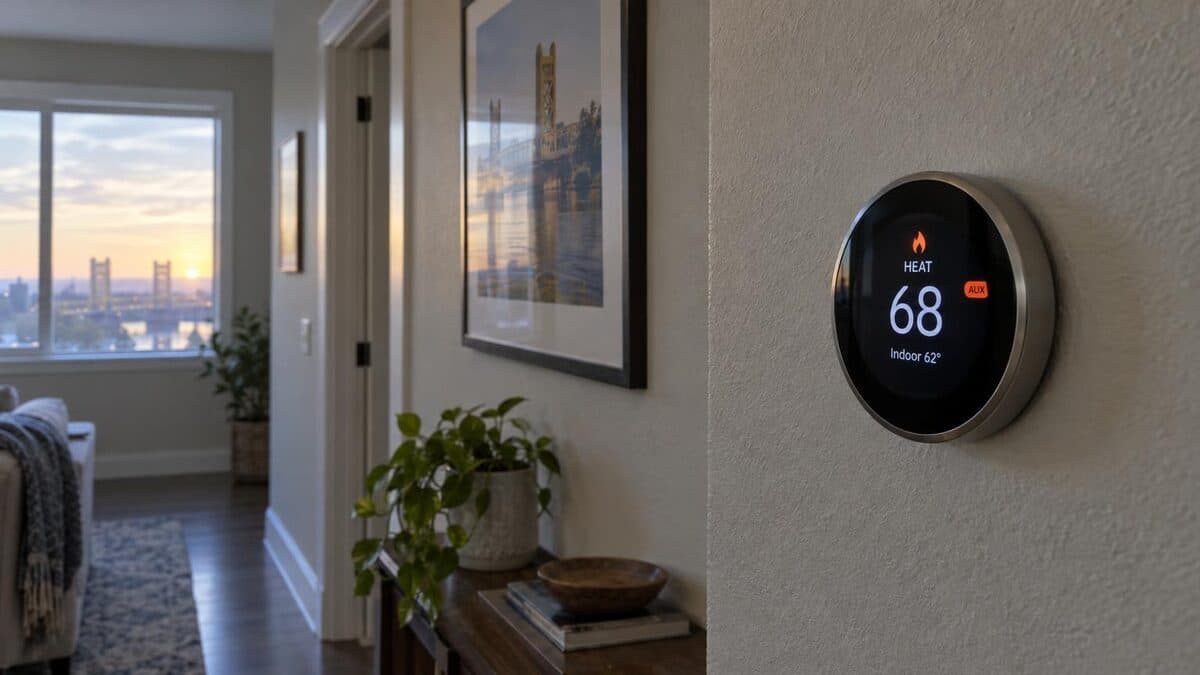
If your heat pump thermostat shows AUX every morning, a deep overnight setback is usually the reason. When the house has cooled several degrees below the morning setpoint, the thermostat brings in the backup electric heat strips to catch up fast. Those strips cost more to run than the heat pump itself, so a big setback can quietly cancel out what you saved overnight. A smaller setback and the right thermostat settings fix most of it.
Thermostat settings are worth getting right. ENERGY STAR estimates that a certified smart thermostat saves about 8% on heating and cooling bills. Most of that comes from sensible setpoints and schedules, and with a heat pump, how the thermostat handles morning recovery matters as much as the schedule itself.
Why a Deep Setback Triggers AUX Heat
A heat pump moves heat rather than making it, so it warms a house steadily but not quickly. When you ask it to raise the temperature by a lot in a short time, most heat pump thermostats bring in a second stage: the auxiliary electric heat strips in the air handler.
Here is how that plays out on a typical Sacramento winter night. You set the thermostat from 68°F down to 60°F at bedtime. Overnight lows in the 30s and 40s pull the house down to 61°F by dawn. At 6 a.m. the schedule jumps back to 68°F. A 7-degree gap is exactly what most thermostats are programmed to treat as "help needed," so AUX comes on and stays on until the house catches up.
Electric resistance heat is simple and reliable, but it is the most expensive way to heat with electricity. The U.S. Department of Energy covers how heat pumps are rated for efficiency; the short version is that the heat pump delivers far more heat per unit of electricity than the strips do. Every morning the strips run is a morning you pay a premium.
How Much to Set Back a Heat Pump Thermostat
For most heat pumps, a setback of about 2 to 4 degrees overnight or while you are away is the sweet spot. It cuts run time without opening a gap large enough to call for the strips at dawn. The trade-off is that a smaller setback saves less overnight, but it avoids paying strip-heat prices every morning.
Our position: in a Sacramento winter, a modest setback beats a deep one with a heat pump almost every time. Our winters are mild compared with most of the country, which is exactly why a heat pump can usually hold the house comfortably on its own. Let it do that instead of forcing a sprint every morning.
A few related habits help:
- Start the morning warm-up earlier and smaller. Raising the setpoint one or two degrees at a time over an hour lets the heat pump keep up.
- Avoid big manual bumps. Turning the thermostat up 5 degrees because the house feels cool is the fastest way to light up AUX.
- Leave it alone when you leave for a few hours. Short absences rarely justify a setback with a heat pump.
The Settings That Keep the Strips Off
Two thermostat features do most of the work, and many homes have them turned off or never set up.
Smart or adaptive recovery. Instead of jumping to the morning setpoint at a fixed time, the thermostat starts warming earlier and more gradually so the house reaches temperature on schedule mostly on the heat pump. Many smart thermostats call this early start or smart recovery, and some still allow the strips during warm-up unless they are set up not to, so check how yours is configured.
Aux heat lockout. This setting uses an outdoor temperature sensor or reading to keep the strips off whenever it is mild enough outside for the heat pump to carry the load. It is usually set by the installer during setup, and it is one of the most useful settings for a Sacramento heat pump, because most of our winter hours are well within what a heat pump handles on its own.
Check also that the thermostat is configured as a heat pump. A thermostat set up for a gas furnace and AC will not manage the auxiliary stage the way a heat pump needs.
What AUX, EM and WAIT Mean on the Display
AUX means the backup strips are running alongside the heat pump, usually during recovery or a defrost cycle. Seeing it now and then is normal.
EM or emergency heat means you have switched the system to run on the strips alone. It is meant for a heat pump that is not working, not for everyday use.
WAIT is a short built-in delay that protects the compressor after it shuts off. It clears on its own within a few minutes.
A Typical Morning AUX Pattern
A typical version of this in Roseville: a 2010s two-story with a heat pump, a thermostat schedule carried over from the old gas furnace, and an 8-degree overnight setback. The owner sees AUX on the display every morning and a winter bill that does not match the heat pump's reputation. Cutting the setback to 3 degrees, turning on smart recovery and confirming the aux lockout setting is usually what brings the mornings back to heat pump only.
When to Call PULSE HVAC
Call us if AUX runs most of the day in mild weather, if your thermostat is not configured as a heat pump, or if you want the aux heat lockout and recovery settings checked. Those are quick fixes that change how much of your heating comes from the strips.
PULSE HVAC services heat pumps and thermostats across the Sacramento area. Call (916) 850-2221 or book online to schedule a heat pump check.
Sources
Need HVAC help in Sacramento?
Same-day service · Free estimates · Licensed & insured