
Reviewed by Paul R., CEO & Installer
The best AC fix is often the one you can make yourself in fifteen minutes: a thermostat set to the wrong mode, a tripped breaker, a clogged filter, a blocked outdoor unit, a full drain pan or an iced-over coil. Work through those six checks before you book a repair and one of them is often the whole problem. ENERGY STAR advises checking your air filter every month and changing it at least every three months, and that single habit prevents more of these calls than any other.
Most of these checks apply to a heat pump too. The U.S. Department of Energy covers central air conditioners and heat pumps together because they share the same basic parts: an outdoor unit, an indoor coil and the controls between them. A heat pump simply adds a winter heating mode.
1. Check the Thermostat
Start with the thermostat, because it causes more "broken AC" calls than people expect.
- Is it set to cool, not heat or off?
- Is the setpoint a few degrees below the current room temperature?
- Is the screen on? Replace the batteries if it has them.
- Is a schedule or away mode overriding your setting?
After you change a setting, give the system a few minutes. Many outdoor units wait before restarting the compressor, so the indoor fan may start first.
2. Check the Breakers and the Disconnect
Check the breaker panel next. Most systems have two breakers: one for the furnace or air handler indoors and a larger one for the outdoor unit. A breaker sitting in the middle position has tripped. Push it fully off, then back on.
If a breaker trips again after one reset, leave it off and call a technician.
Then look at the disconnect box on the wall next to the outdoor unit. Someone mowing, painting or pulling weeds sometimes switches it off or pulls its handle. Make sure it is in the on position. Do not open the box beyond that.
3. Change the Air Filter
A clogged filter starves the system of air. That can make it cool weakly, run constantly, or freeze the indoor coil. Pull the filter and hold it up to a light. If you cannot see through it, replace it. Our guide to finding your filter size helps if you are not sure what to buy.
4. Clear the Outdoor Unit
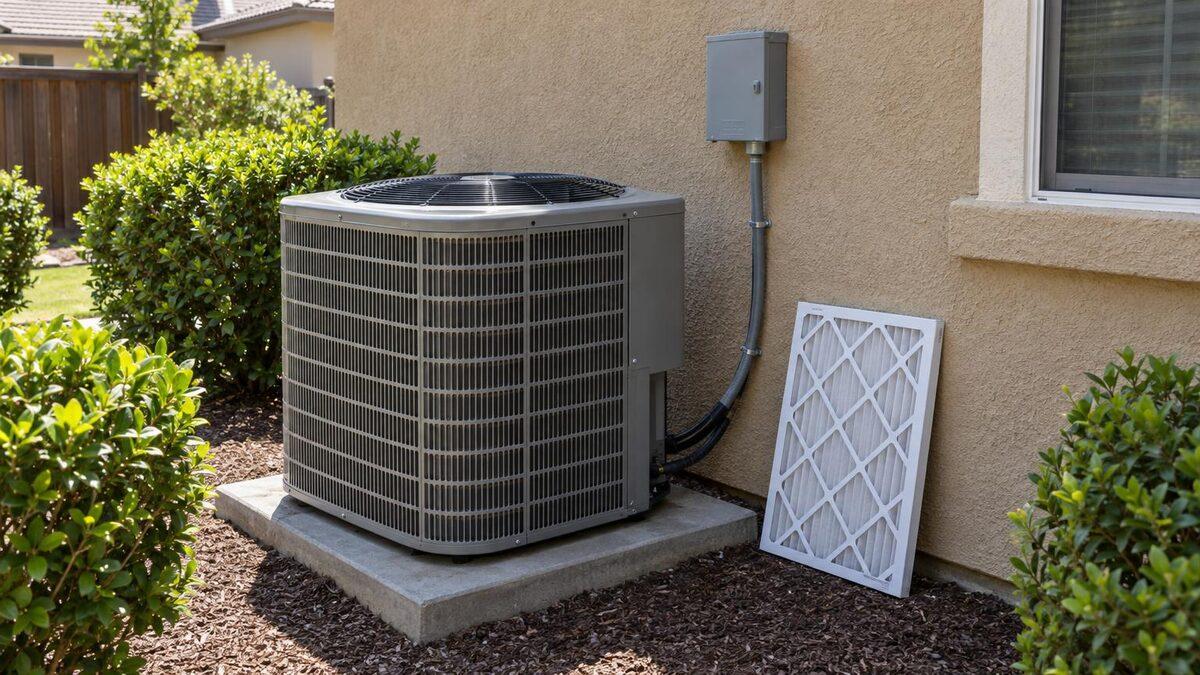
The outdoor unit needs to pull air through its coil to dump heat. Leaves, grass clippings, a pushed-up shrub or a stack of stored items cut that airflow. Around Sacramento, the cottony seed fluff that drifts off trees in late spring and the dust from long dry summers both mat onto the fins, and on a triple-digit afternoon that coating is enough to make the system struggle. Turn the system off at the thermostat and at the outdoor disconnect, clear the outside of the coil by hand, and keep about two feet open around the sides. Our post on leaves in the outdoor unit covers how to clean it without bending the fins.
5. Check the Condensate Drain
If the system shut off and you see water around the indoor unit, the condensate drain is the likely cause. The drain carries water from the indoor coil outside or to a drain. When it clogs, water backs up into the pan, and a float safety switch shuts the system off to prevent an overflow.
Here is how it usually looks on a typical summer call in a Sacramento attic install. The AC stopped mid-afternoon, the thermostat is on, and the breakers are fine. In the attic, the secondary pan under the air handler holds an inch of water and the float switch has tripped. Clearing the drain line, emptying the pan and resetting the switch gets it running again. Our post on a clogged AC drain line walks through it.
6. Thaw a Frozen Coil
A frozen indoor coil looks like frost or ice on the copper line near the indoor unit, and the system blows warm or weak air. Set the thermostat to off and the fan to on, and let the ice melt. That can take a few hours. Then replace the filter and make sure the return and supply vents are open.
When It Is Not a DIY Fix
Stop and call a technician when the breaker trips again after a reset, the outdoor unit hums but its fan never spins, the coil freezes again with a clean filter, or the problem involves refrigerant, capacitors or wiring. Those need testing and parts, and a misdiagnosis gets expensive fast.
When to Call PULSE HVAC
Call us when you have worked through the checklist and the system still will not cool, keeps shutting off, or makes a new noise. We repair air conditioners and heat pumps across the Sacramento area, often the same day.
Call PULSE HVAC at (916) 850-2221 or book a repair online.
Sources
Need HVAC help in Sacramento?
Same-day service · Free estimates · Licensed & insured