
Reviewed by Paul R., CEO & Installer
UV lights for HVAC do one job well and get sold for another. Aimed at the indoor coil and drain pan, a UV lamp helps keep those damp surfaces cleaner. Sold as a whole-home air cleaner, it does much less than the brochure suggests, because the air rushes past the lamp too fast for the light to do much. For most Sacramento homes, a better-fitted filter is the smarter first purchase.
The EPA's guide to air cleaners is blunt on this point: typical UV air cleaners used in homes have limited effectiveness. That is worth knowing before you add one to a tune-up invoice. The filter, by contrast, needs regular attention to do its job: ENERGY STAR recommends checking it every month during heavy use and changing it at least every three months.
What a UV Light in an HVAC System Actually Does
There are two kinds of HVAC UV lamps, and they do different things.
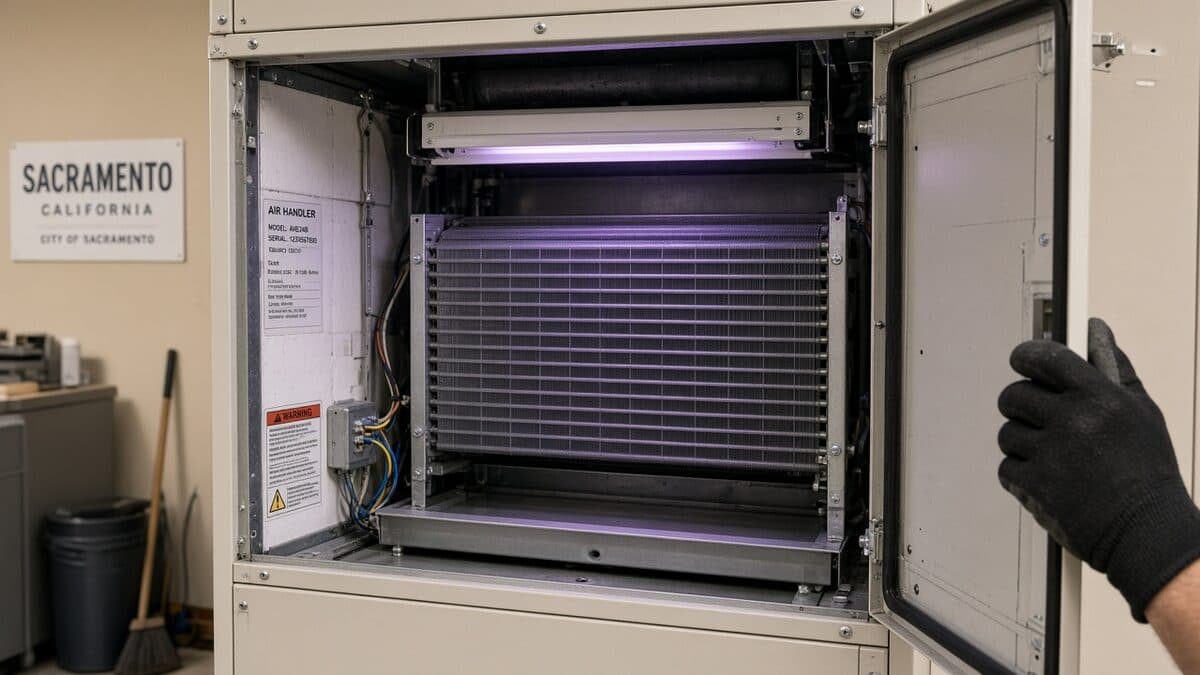
Coil-facing lamps mount inside the air handler and shine on the indoor coil and the drain pan below it all the time. Those surfaces stay damp through every cooling season, and over time they can build up a slimy film that slows airflow and causes a musty smell. Constant UV exposure helps keep that growth down. This is the use that holds up best.
Air-stream lamps mount in the ductwork and aim at the moving air. The idea is to treat the air as it passes. The problem is time. Air moves through a duct in a fraction of a second, and a lamp only affects what it is exposed to long enough. That is why the EPA calls typical home units limited.
Should You Buy a UV Light or a Better Filter?
No, not for the air you breathe. A UV lamp does not capture anything. A filter does. Every time the blower runs, a well-fitted pleated filter catches dust, pollen and many fine particles and holds them out of the air.
The EPA's explanation of MERV ratings covers how higher-rated filters capture progressively smaller particles. For most homes, a MERV 8 to 13 pleated filter that actually fits its slot does more for indoor air than any lamp. If your system can handle MERV 13 without choking airflow, that is the upgrade to make first. It also pays off during Sacramento's wildfire smoke weeks, when fine particles are the main problem indoors and a UV lamp does nothing to catch them.
Our position: buy the filter upgrade before the UV light, every time. Fix the gaps around the filter slot, seal leaky returns, and change the filter on schedule. Then, if the coil itself keeps fouling, look at a coil-facing lamp.
When a Coil-Facing UV Lamp Makes Sense
A coil-facing lamp makes sense when the coil or drain pan keeps getting dirty or musty even with a good filter in place. Signs include:
- A musty smell when the AC first starts that comes back after cleaning.
- A drain pan that keeps growing slime and clogging the condensate line.
- A coil that needs cleaning more often than every few years.
Sacramento's dry climate works in your favor here. Our summer air is low in humidity compared with coastal or humid regions, so many coils in the area stay reasonably clean with good filtration alone. A lamp is a fix for a specific problem, not standard equipment.
What UV Lights Cost to Keep
The lamp is not a one-time purchase. Most HVAC UV bulbs are rated for about a year of continuous use, and their output fades even while they still glow, so a lamp that looks fine may be doing little. Plan on replacing the bulb on the manufacturer's schedule, usually during the annual tune-up.
Two other details matter:
- Choose an ozone-free lamp. Some UV lamps emit a wavelength that creates ozone, a lung irritant you do not want circulating indoors. Lamps sold as ozone-free avoid it.
- Have it installed by a technician. The lamp goes inside the air handler, and it should switch off when the access panel is removed.
A Typical Upsell
The UV light offer usually arrives before the basics are fixed. A typical version comes up during a fall tune-up in Folsom. The technician offers a UV light to "clean the air." The house has a builder-grade 1-inch filter with a gap around the edges, and the return grille is dusty. In that house, the honest order of operations is a properly sized pleated filter, a sealed filter slot and a coil check. If the coil turns out to be clean, the UV light can wait.
When to Call PULSE HVAC
Call us if your system smells musty when it starts, if the drain pan keeps clogging, or if you want an honest look at whether your filter setup or your coil is the real issue. We check filter fit, return leaks and coil condition before recommending any add-on.
PULSE HVAC serves homeowners across the Sacramento area. Call (916) 850-2221 or book online to schedule an indoor air quality check.
Sources
Need HVAC help in Sacramento?
Same-day service · Free estimates · Licensed & insured