
Reviewed by Paul R., CEO & Installer
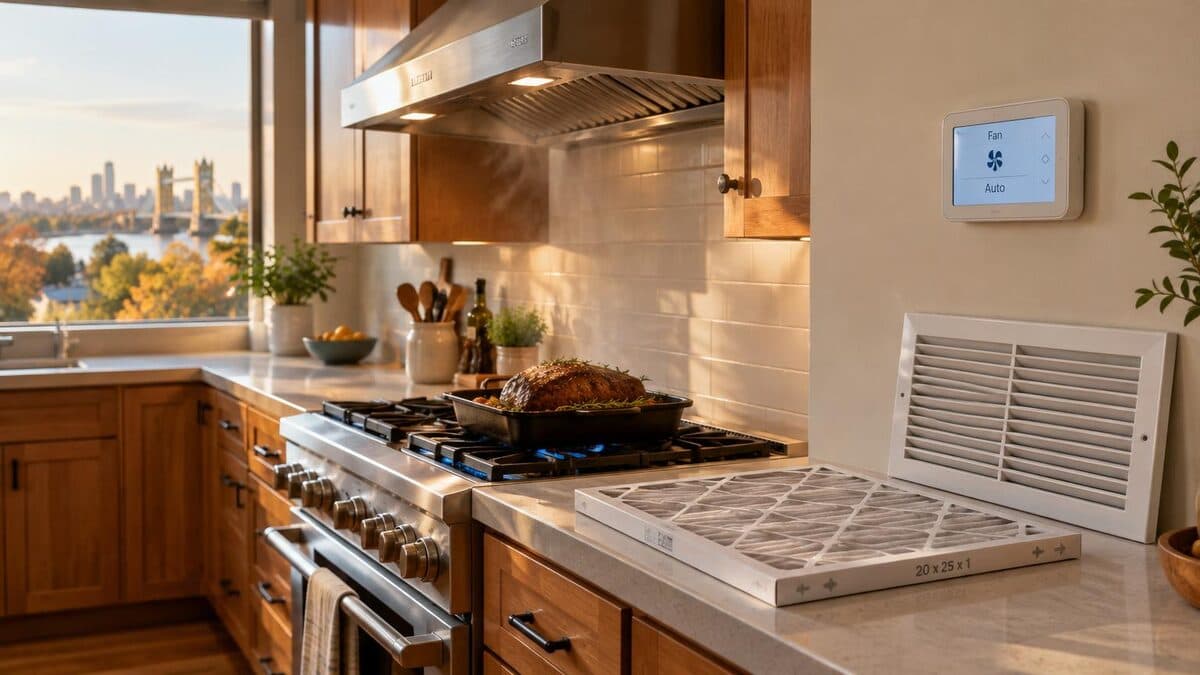
Yes, a long holiday cooking day can grease your ducts if the furnace blower is left on circulate, and it is a common reason homeowners start looking into Sacramento duct cleaning after the season ends. On circulate, the blower runs for part of every hour whether or not the system is heating, and on "On" it runs nonstop. It pulls grease aerosols from the stovetop into the return grille and pushes them through every run in the house. The fix costs nothing: set the thermostat fan to auto, and run the range hood if it vents outdoors. If yours only recirculates, crack a kitchen window while you cook unless the AQI is above 100.
Holiday cooking in October and November has a local wrinkle. Afternoons in the valley are often still warm enough that nobody wants the furnace running, and fall inversions can hold smoke and haze low over the valley for days. AirNow rates an AQI of 51 to 100 as "Moderate," which is acceptable for most people, but plenty of hosts keep the house shut anyway. The windows stay shut, the house fills with guests, someone flips the fan to "On" to move air around, and the kitchen's grease ends up in the ductwork.
Why does the fan setting matter so much?
The fan setting decides whether your blower acts as a kitchen exhaust fan, and it is a bad one. On auto, the blower runs only when the system is actively heating or cooling. On a mild afternoon that is rarely, so kitchen air mostly stays in the kitchen until the range hood removes it.
On "On," the blower moves air through the return all afternoon. Circulate is gentler, running the fan on a timer (about a third of the time on many thermostats, such as Resideo's T9), but over a long cooking day that still adds up to hours of return airflow. Searing, roasting, and frying throw off a fine grease mist that hangs in the air. The return grille sucks it in, and your filter catches some of it. The rest coats the blower wheel and the inside of the duct runs, and it holds dust like flypaper.
EPA's indoor air quality guidance names cooking as an indoor pollutant source and lists ventilation as a core way to control it. A recirculating blower is not ventilation. It moves the same air around the house and spreads grease, moisture, and odors into bedrooms that were fine before dinner started.
My position: leave the fan on auto from the time the oven preheats until the dishes are done. Circulate has its uses on other days. Cooking day is not one of them.
How should the range hood run?
The range hood should vent outdoors and run the whole time anything is on a burner, plus a few minutes after the pans come off the heat. An outdoor-venting hood is the only thing in the kitchen that actually removes grease and cooking particles from the house.
Plenty of Sacramento-area homes have recirculating hoods, especially condos and kitchens remodeled without running a new duct to the roof or an exterior wall. A recirculating hood passes air through a small mesh or charcoal filter and blows most of it back into the room. That is exactly where a circulating blower will pick it up. If yours recirculates, keeping the HVAC fan on auto matters even more.
A few habits help on the big day:
- Turn the hood on before the first pan heats, not after the smoke shows up.
- Use the back burners for searing and frying. Most hoods capture better there.
- Clean or replace the hood's grease filter before the holiday, not after.
- Keep the hood running for a few minutes once cooking stops.
Is a filter upgrade worth it for one week?
Yes, a one-week filter step-up is worth doing, as long as you treat it as backup and not the plan. A higher-efficiency pleated filter catches more of the grease mist and fine particles that get past the hood. Filter efficiency is rated on the MERV scale defined by ASHRAE Standard 52.2. Stepping up from a basic fiberglass panel to a mid-range pleated filter is a meaningful jump.
There is a trade-off. Denser filters restrict airflow from the moment the blower starts, and some older systems with undersized returns cannot handle that even for a week: airflow drops, which can trip the furnace's high-limit switch on a heating call (or freeze the coil if the AC is still running). Only step up to a rating your furnace or air handler manual lists, or that a technician has confirmed fits your system. If it does fit, one week is still the plan, not permanently. Put the better filter in a day or two before the holiday. Check it after the party, and if it looks tacky, discolored, or loaded, replace it. Then go back to your usual filter.
What you should not do is leave the blower on circulate to "clean the kitchen air" through the new filter. The filter catches part of the grease. The ducts get the rest.
Can you just open the windows instead?
Often you can. AirNow rates an AQI of 51 to 100 as acceptable for most people, and EPA recommends opening windows or doors when you cook without a hood that vents outdoors. If your hood recirculates, a window cracked near the kitchen is your best exhaust.
Keep the house shut when someone at home has asthma or another sensitivity to outdoor air, when wildfire smoke is in the forecast, or when the reading climbs past 100. Check the current reading on AirNow before you open anything, and leave the HVAC fan on auto either way.
What does greased ductwork look like?
Greased ductwork shows up as sticky, gray-brown fuzz on the return grille and a filter that feels tacky instead of dusty. Picture a typical case: a 1970s tract house in Elk Grove where the family hosts for three straight days with the fan on circulate. Pull the return grille afterward and you might find a film you can drag a fingernail through, a filter glazed on the intake side, and a matte coating on the first few feet of the return duct that holds lint in clumps. Many tract homes of that era have a hallway return only a short, straight shot from the stove, which makes this worse.
One heavy weekend usually means a greasy filter and grille, not ruined ducts. Replace the filter, wipe the grille with warm water and dish soap, and you are mostly done. Years of the same pattern is different. Grease buildup in the return and on the blower wheel is a legitimate reason for cleaning.
People ask how much duct cleaning costs. Price depends on the number of runs, attic access, and how much buildup there is, so we quote after looking rather than over the phone. Skip routine annual cleaning. It rarely changes airflow enough to notice. Book it when there is a real cause like grease, rodents, or construction dust.
Replacement is a separate question from cleaning. Ducts are worth replacing when they are torn, crushed, or disconnected in the attic, or when old flex duct has degraded. Grease alone is not a reason to replace them.
When to Call PULSE HVAC
Call us if your return grille or filter is still sticky after a cleaning, if you smell cooking odors from bedroom vents days after the meal, or if you want a technician to check whether your blower wheel and return duct picked up grease over the holidays. We will tell you plainly whether you need cleaning or just a fresh filter.
Reach PULSE HVAC at (916) 850-2221, or book a visit online at /book.
Sources
Need HVAC help in Sacramento?
Same-day service · Free estimates · Licensed & insured