
Reviewed by Paul R., CEO & Installer
Thermostat location decides when your heating and cooling turn on and off, because the thermostat only knows the temperature of the few inches of air around it. Put it in the right spot and the whole house follows. Put it in the wrong one and the system shuts off while the living room is still cold, or runs long after the bedrooms are comfortable. ENERGY STAR estimates that a certified smart thermostat saves about 8 percent on heating and cooling bills, but no thermostat saves anything when it reads a temperature nobody in the house actually feels.
The good news: most placement problems are easy to spot and cheaper to fix than people expect.
Where a Thermostat Belongs
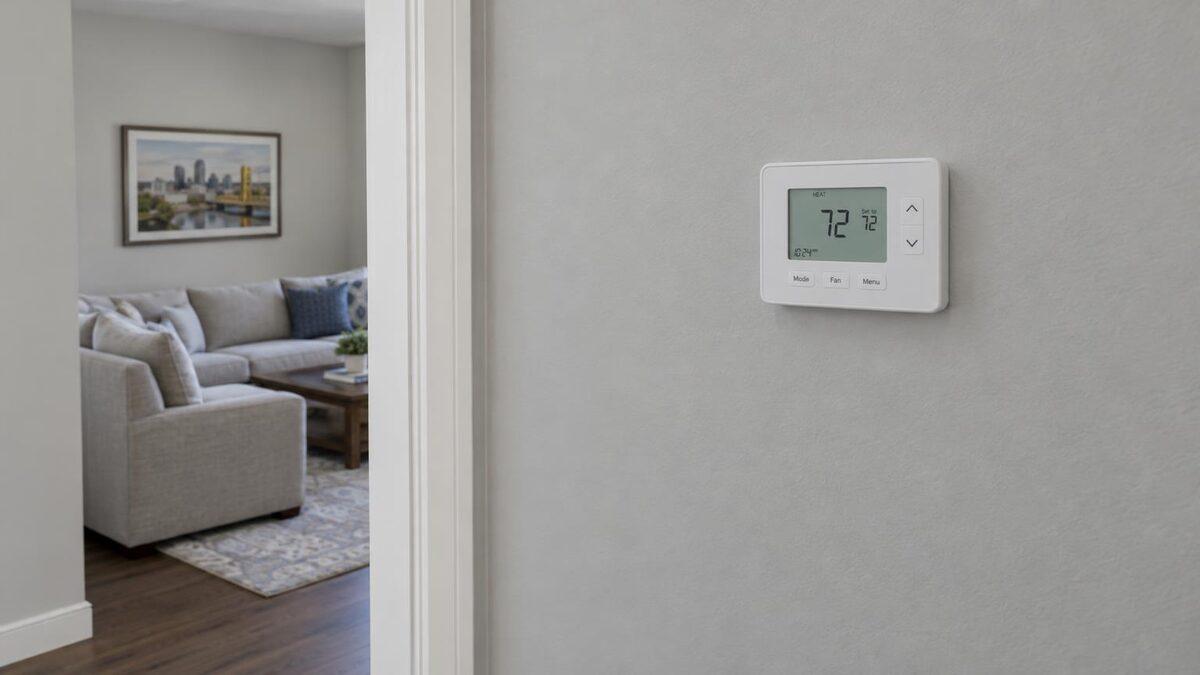
A thermostat belongs on an interior wall in a central room you use every day, about five feet off the floor. In most Sacramento homes that means the living room or a main hallway that opens straight onto it. The spot should get normal room air, the same air you are sitting in, and nothing else.
About five feet is the common height in installation instructions, roughly eye level. Mount it near the ceiling and it reads the warmest air in the room, so the heat shuts off early. Mount it near the floor and it reads the coolest. If someone in the house uses a wheelchair, a slightly lower mount within easy reach is a fine trade.
The Spots That Throw Off the Reading
The spots that throw off a thermostat are the ones with their own little climate. The most common:
- Direct sun. A wall that catches afternoon light through a west window can read several degrees warm, so the heat quits early and the AC runs late.
- Supply vents. Air blowing across the thermostat tells it the job is done before the rest of the room gets the message.
- Exterior walls. They run cool in winter and warm on summer afternoons.
- Near exterior doors and windows. Every time the front door opens on a cold morning, the thermostat feels it.
- Kitchens and bathrooms. Ovens, stovetops and hot showers create short heat spikes.
- Heat sources. A lamp, a TV, or a cabinet of electronics right below the thermostat warms it all evening.
Return grilles are a different story. A thermostat near a return reads well-mixed room air, which is usually fine.
The Draft You Cannot See
One problem hides inside the wall. The thermostat wire comes through a hole drilled from the attic or crawlspace, and in many older homes nobody sealed it. On a cold Sacramento night, attic air drifts down the wall cavity and out through that hole, right onto the sensor.
The thermostat reads cold and calls for heat. The house overheats. Pull the thermostat off its base plate and look: if the hole around the wire is open, plug it with a small piece of foam or putty. It takes five minutes and is one of the cheapest comfort fixes in the house.
When a Two-Story Fools the Thermostat
A two-story house adds a stairwell, and a stairwell is a trap. Here is how it usually looks in a typical 1990s two-story around Sacramento. The thermostat sits in the downstairs hallway at the foot of the stairs. In winter, warm air rises up the stairwell, so the downstairs hall stays cool and the thermostat keeps the furnace running. By the time the hallway is comfortable, the upstairs bedrooms are several degrees too warm. In summer the problem flips.
Moving the thermostat a few feet does not fix a whole-floor imbalance. A remote sensor, or a zoned system in the bigger cases, does.
Move It or Add a Sensor?
Moving a thermostat makes sense when the current spot is plainly bad and a better wall is close. A technician runs new thermostat wire from the furnace or air handler and patches the old hole. In a single-story ranch with an attic overhead, that is usually a short job. In a two-story, or a wall with fire blocking inside, it takes more work.
A remote sensor is often the easier fix. Many smart thermostats accept wireless room sensors, such as the ecobee SmartSensor or the Google Nest Temperature Sensor, and can use a sensor's reading, or an average of several, instead of their own. That lets a thermostat stuck in a poor spot respond to the bedroom or living room you actually care about, with no new wire.
Our position: try the sensor first when the thermostat already supports one. Move the thermostat when the spot is a real problem, like a wall over a supply vent or in full afternoon sun, and when you are replacing the thermostat anyway.
If the reading is right but the house still does not match it, the cause is not the thermostat. Our post on a thermostat reading the wrong temperature walks through airflow and equipment causes.
When to Call PULSE HVAC
Call us when the rooms you use never match the thermostat, when you want a thermostat moved to a better wall, or when you want a smart thermostat with remote sensors installed and set up. We can check the location, the wiring and the system in one visit.
Call PULSE HVAC at (916) 850-2221 or book a visit online.
Sources
Need HVAC help in Sacramento?
Same-day service · Free estimates · Licensed & insured