
Reviewed by Paul R., CEO & Installer
Smart vents for HVAC can help with small comfort problems, and they can hurt when they are asked to do a big job. A smart vent is a motorized register that replaces an ordinary floor or ceiling vent, opens and closes on its own, and takes its cue from room sensors and an app. Used on a few rooms to trim airflow, they work. Used to shut down half the house, they push your system outside the airflow it was designed for. ENERGY STAR estimates that heating and cooling make up as much as half of the energy used in a typical home, so how air moves through your ducts shows up on the bill either way.
How Smart Vents Work
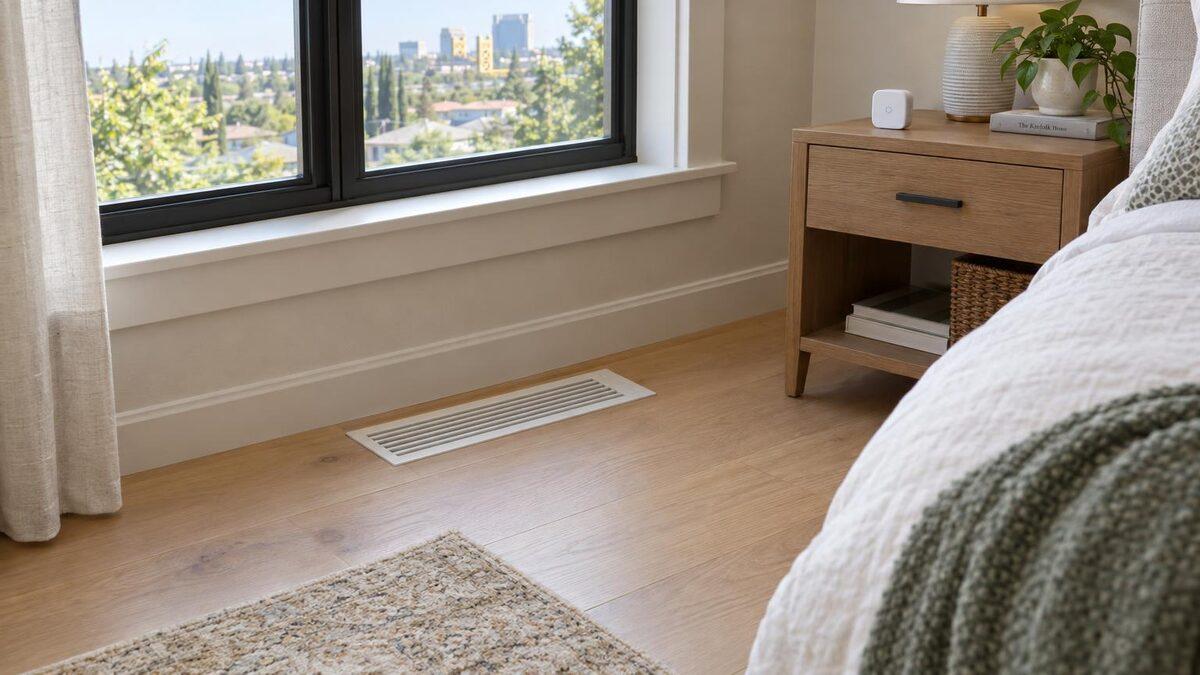
Picture a regular register with a small motor that moves the louvers. That is a smart vent; Flair is one of the better-known brands. Most run on batteries or plug into a nearby outlet, and they talk to a hub or app over your home network. Temperature sensors in each room, either built into the vent or set on a shelf, report back. When a room reaches its setpoint, its vent closes partway or fully, and the air goes elsewhere.
Many smart vent systems connect to popular smart thermostats, including ecobee and Google Nest models, so the vents can respond when the thermostat calls for heat or cooling. Keep the savings claims straight: ENERGY STAR estimates that a certified smart thermostat saves about 8 percent on heating and cooling bills. That figure is for the thermostat, not for the vents. Check the vent maker's compatibility list for your exact thermostat model, because support varies by brand and generation.
The Problem With Closing Too Many
Closing regular vents and closing smart vents run into the same limit: a central system is built to move a certain amount of air. Your blower does not slow down because some registers shut. It pushes against the closed ones, duct pressure rises, and total airflow drops.
That shows up in a few ways:
- In heating, a furnace with too little air running across it gets hot enough to trip its high-limit switch and shut off early.
- In cooling, the indoor coil gets too cold and can ice over.
- In the ducts, higher pressure pushes more air out of every leaky joint, often into the attic.
Our post on closing vents in unused rooms covers that pressure problem in detail. Smart vents automate the same move, so they inherit the same limit.
When a Few Smart Vents Make Sense
Small corrections are where they earn their place. Here is how it usually looks in a typical single-story Sacramento ranch: the west-facing bedroom runs a couple of degrees warmer on fall afternoons, and the living room near the thermostat runs a little cool. Two smart vents, one in the warm bedroom set to close partway in the afternoon and one in the living room left open, even out the difference. The rest of the house keeps its regular registers, so the system still moves close to its full airflow.
Keep three rules in mind:
- Close only a small share of the registers, a few rooms at most.
- Prefer partly closed over fully closed. Some systems let you cap how far vents close.
- Have the duct pressure measured with the smart vents in their most-closed position before you rely on them. A technician can do that with a manometer in a few minutes.
Better Fixes for Uneven Rooms
Start with the cause, not the register. Most rooms that run too hot or too cold have a reason you can fix in the ducts or the building:
- Manual balancing dampers in the duct runs shift airflow between rooms permanently, with no batteries or app.
- Sealing and insulating attic ducts brings more warm or cool air to the far rooms. Our post on the duct leakage test explains how to measure the leaks.
- Adding a return path to a closed-off bedroom lets air flow in when the door is shut.
- A zoned system with dampers and its own thermostats does what smart vents try to do across a whole floor, with controls designed for it. Our post on zoned HVAC systems covers how it works.
Our position: fix the duct and building causes first, then use smart vents for fine-tuning in one or two rooms, if at all.
When to Call PULSE HVAC
Call us when rooms stay uneven, when you are thinking about smart vents and want the duct pressure checked first, or when the system started short cycling or icing after smart vents went in. We can measure static pressure and airflow room by room and tell you whether smart vents, balancing or duct work is the right fix.
Call PULSE HVAC at (916) 850-2221 or book a visit online.
Sources
Need HVAC help in Sacramento?
Same-day service · Free estimates · Licensed & insured